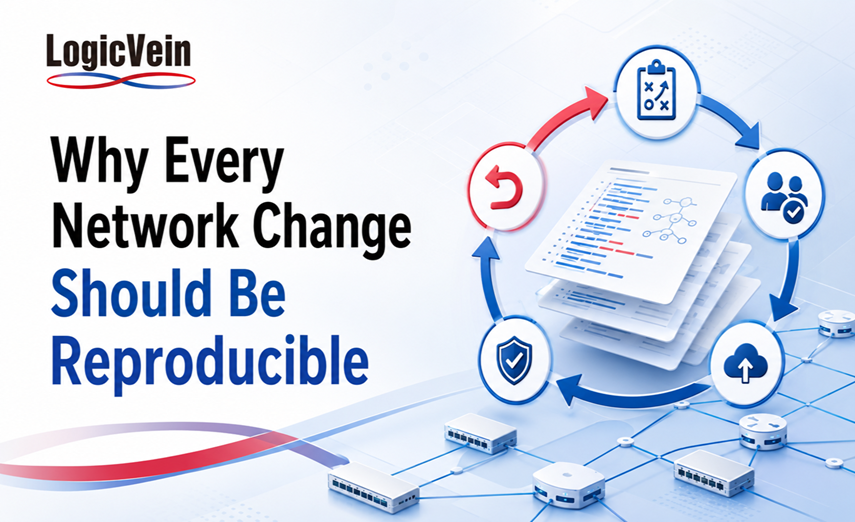

Why Every Network Change Should Be Reproducible
Network changes happen every day. An access control list is updated, a VLAN is added, a routing policy is adjusted, or an interface is reconfigured to support a new service.
When the change works, the ticket is closed and everyone moves on.
But could your team reproduce that exact change tomorrow on another device? Could someone explain precisely what was changed, why it was changed, and how to reverse it? Would the outcome be the same if a different engineer performed the work?
If the answer is no, the organization does not have a repeatable change process—it has a collection of one-time events. Every network change should be reproducible because reproducibility turns individual technical knowledge into a reliable operational capability.
What Does a Reproducible Network Change Look Like?
A reproducible network change is documented and structured well enough that another qualified engineer—or an automation platform—can perform the same operation and achieve the same result. That means the change includes more than a few CLI commands copied into a ticket.
It should clearly define:
-
The purpose of the change
-
The devices and interfaces affected
-
The required starting conditions
-
The exact configuration steps
-
Device-specific variables
-
Pre-change and post-change validation
-
Approval requirements
-
Expected results
-
Rollback procedures
-
A record of what was actually executed
Reproducibility does not mean every network device must have an identical configuration. It means the process used to create, validate, and verify a change is consistent—even when device-specific values are different.
Manual Changes Depend Too Much on Memory
Experienced network engineers often know exactly what needs to be done. They understand the environment, remember previous issues, and can make adjustments quickly. That knowledge is valuable, but it can also become an operational risk when the change process exists only in someone’s memory.
A manual change may depend on an engineer remembering:
-
Which command syntax applies to a particular platform
-
Which interfaces must be excluded
-
Which configuration must be entered first
-
Which service requires a restart
-
Which validation command confirms success
-
Which previous workaround is still required
Even highly skilled engineers can forget a step, mistype a value, or make different decisions under pressure. If every engineer performs the same task differently, the network gradually becomes inconsistent and more difficult to support.
A reproducible process captures that knowledge and makes it available to the entire team.
Reproducibility Reduces Configuration Drift
Configuration drift rarely results from one major decision. It usually develops through hundreds of small differences introduced over time. One switch receives an updated SNMP configuration while another is missed. A temporary access list remains in place. A routing policy is applied differently at a remote location. An emergency change fixes the immediate problem but is never incorporated into the standard configuration. Individually, these differences may appear harmless.
Collectively, they create an environment in which devices that should behave the same way no longer do. Reproducible changes help prevent this drift by applying the same approved logic across every relevant device. Templates, variables, device groups, and validation rules allow teams to standardize the process while still accommodating legitimate differences between devices.
Reproducibility Makes Troubleshooting Faster
When an outage follows a network change, the first question is usually: “What changed?” That question should have a precise answer.
Without a reproducible change record, troubleshooting may require engineers to compare configurations manually, review terminal history, contact the person who performed the work, and reconstruct the sequence of events from memory.
A reproducible process provides immediate visibility into:
-
The configuration before the change
-
The commands or playbook that were executed
-
The values supplied to the process
-
The time the change occurred
-
The user who initiated or approved it
-
The configuration after the change
-
The validation results
This information allows the operations team to determine whether the change caused the problem and identify exactly which step may need to be reversed.
Rollback Must Be Part of the Change
A rollback plan should never be an afterthought added to satisfy a ticket requirement.
If a change cannot be reversed predictably, it is not fully reproducible.
A useful rollback process must account for the actual state of the device before the change. Simply entering the opposite command may not restore that original state, especially when the change affects multiple configuration sections or when commands have platform-specific side effects.
A dependable process captures a current configuration backup, identifies the relevant differences, and defines the conditions under which rollback should occur. Whenever possible, the rollback steps should be tested with the same care as the primary change.
The goal is not merely to know what commands might undo the work. The goal is to know that the network can be returned to its previous operational state.
Automation Turns Reproducibility into Scale
A written procedure is a good starting point, but automation makes reproducibility practical across large and diverse networks. LogicVein's automation playbooks can define the sequence of operations while using variables for device-specific information such as:
-
Hostnames
-
IP addresses
-
VLAN IDs
-
Interface names
-
Access control entries
-
Site-specific parameters
The playbook can also perform pre-change checks, stop when required conditions are not met, validate the result, and record the outcome. This turns a change from a set of instructions that someone must interpret into an executable process that can be reviewed, approved, tested, and reused. Automation does not remove engineers from the process. It allows engineers to apply their knowledge once and then use it consistently.
Approvals Become More Meaningful
Approving a vague change request is difficult. A ticket may describe the goal without showing exactly how it will be achieved. A reproducible change gives the reviewer something concrete to evaluate.
Before approving the work, the reviewer can examine:
-
The exact scope of the change
-
The devices that will be affected
-
The commands or automation steps
-
The variables that will be used
-
The validation criteria
-
The rollback procedure
This creates a stronger separation between planning, approval, and execution. It also reduces the likelihood that an approved change will be implemented differently from what the reviewer expected.
Reproducibility Supports Compliance and Auditing
Regulated organizations must often demonstrate that network changes are authorized, traceable, and consistent with policy.
A reproducible process creates the evidence needed to answer important audit questions:
-
Who requested the change?
-
Who approved it?
-
What configuration was modified?
-
Which devices were affected?
-
When was the work performed?
-
Did the change produce the expected result?
-
Was the final configuration compliant with policy?
Instead of assembling this information from multiple systems after the fact, organizations can capture it as part of the change workflow. This makes compliance a built-in operational outcome rather than a separate reporting exercise.
Start with the Changes You Perform Most Often
Not every network procedure must be automated immediately. The best place to begin is with changes that are frequent, repetitive, high-risk, or commonly performed across multiple devices.
Good candidates include:
-
Updating SNMP communities or monitoring settings
-
Modifying NTP and DNS configurations
-
Applying access control list changes
-
Creating VLANs
-
Updating login banners
-
Changing interface configurations
-
Rotating local credentials
-
Deploying security-related configuration updates
For each process, document the current workflow, identify required variables, define validation checks, and create a tested rollback procedure. The process can then be converted into a reusable template or automation playbook. Over time, the organization develops a library of approved and proven change procedures.
From One-Time Changes to Operational Confidence
A successful network change should produce more than a correctly configured device. It should produce a repeatable method the organization can use again.
Reproducibility reduces human error, limits configuration drift, improves troubleshooting, strengthens compliance, and makes automation safer. Most importantly, it ensures that the network does not depend entirely on who happens to be making the change.
LogicVein Net LineDancer helps network teams build reproducible change processes through automated configuration backups, detailed change tracking, approval workflows, reusable playbooks, compliance validation, and configuration comparison.
When every change can be reviewed, repeated, verified, and reversed, network operations become more predictable—and predictable networks are easier to manage, secure, and scale.
Final Takeaway
With LogicVein, you don’t just react to changes — you control them.
Watch our series of videos here or see all our features here.
With its combination of discovery, monitoring, compliance, and automation, LogicVein transforms how IT teams manage complex network environments.
Whether you’re looking to reduce manual work, improve network reliability, or gain better visibility into device configurations, LogicVein will provide you the tools you need—all in a single platform.
Ready to see LogicVein in action? Request a Demo and discover how you can simplify operations, improve reliability, and gain full network visibility.