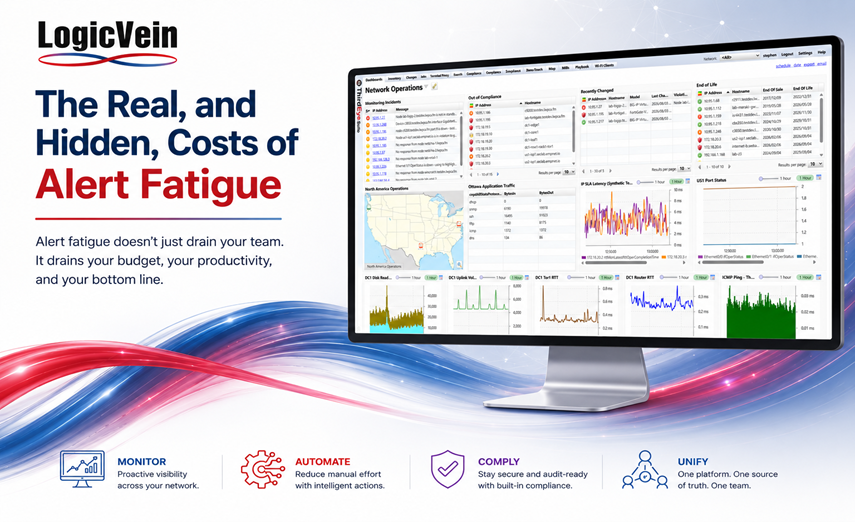

The Real, and Hidden Costs of Alert Fatigue
Most organizations underestimate what alert fatigue is actually costing them. Fortunately, you can estimate the impact with a relatively simple calculation.
Time spent per alert × Employee hourly cost × Number of noise alerts = Daily cost of wasted triage
The figures below use a representative example—not a universal benchmark. Adjust the number of alerts, analyst salaries, review times, and turnover assumptions to match your own environment.
Assume a team of 10 NOC administrators, an average fully loaded labor cost of $48/hour, and approximately 10,000 alerts per day. Of those, around 1,000 alerts require individual triage (roughly three minutes each), while the remaining 9,000 alerts receive only a quick dashboard glance (approximately ten seconds each).
1. Direct Triage Cost
| Period | Formula | Result |
|---|---|---|
| Daily | (1,000 × 3 min ÷ 60) × $48 + (9,000 × 10 sec ÷ 3600) × $48 | 50 hrs × $48 + 25 hrs × $48 = $3,600/day |
| Monthly | $3,600 × 20.83 working days | ~$74,988/month |
| Yearly | $3,600 × 250 working days | $900,000/year |
Note: These are average review times. Some incidents require substantially more effort while others require less.
Then there's the refocus penalty: after any interruption, it takes an average of 23 minutes to fully return to a complex cognitive task (Gloria Mark, UC Irvine — https://ics.uci.edu/~gmark/).
2. Context-Switching Penalty
Applying the 23-minute refocus only to the genuinely triaged subset (1,000/day) that plausibly interrupts focused work, at 20%: 200/day.
| Period | Formula | Result |
|---|---|---|
| Daily | (200 × 23 ÷ 60) × $48 | 76.7 hrs × $48 = $3,680/day |
| Monthly | $3,680 × 20.83 | ~$76,654/month |
| Yearly | $3,680 × 250 | $920,000/year |
3. Employee Retention & Replacement Cost
Alert fatigue contributes to burnout, and burnout contributes to employee turnover.
Turnover cost is well-established: the Society for Human Resource Management (SHRM) formula puts it at 1–1.5x annual base salary. What's harder to pin down is how many departures alert fatigue directly causes, so "2 departures" below is an illustrative assumption. Swap in your own data if you have it.
| Period | Formula | Result |
|---|---|---|
| Daily | Yearly ÷ 250 | ~$801–$1,202/day |
| Monthly | Yearly ÷ 12 | ~$16,689–$25,033/month |
| Yearly | 2 departures × ($100,132–$150,198) | $200,264–$300,396/year |
Total Estimated Cost
| Period | Total |
|---|---|
| Daily | ~$8,081–$8,482 |
| Monthly | ~$168,331–$176,675 |
| Yearly | ~$2.02M–$2.12M |
Even if your own numbers are half this example, many enterprise NOCs are still losing hundreds of thousands of dollars every year simply processing alerts that never should have existed.
Try plugging in your own numbers to see where your organization stands.
These costs are relatively straightforward to calculate; it just takes some time to collect the data. But there are other costs that don’t readily appear on the bottom-line:
Erosion of Trust
When the majority of alerts are false positives, engineers naturally begin raising their threshold for what deserves attention. Unfortunately, legitimate alerts begin getting ignored alongside the noise.
Institutional Knowledge Walking Out the Door
Every monitoring environment develops unwritten rules:
"That alert always fires during the weekend backup."
"Ignore this one after patch Tuesday."
When experienced engineers leave, that tribal knowledge leaves with them, forcing new team members to relearn years of operational behavior.
Leadership Confidence Erosion
When a team has lost confidence in the quality of its own alerts, reporting "alerts processed" up to leadership starts to feel performative rather than meaningful. This quietly erodes leadership's confidence in the monitoring investment itself over time
Decision Quality Under Sustained Fatigue
Over time, fatigued engineers start taking “shortcuts” when clearing alert queues instead of doing a proper investigation. This shows up in outcomes: missed early-warning signs, overlooked correlations between related alerts, and more that eventually affect the stability of and trust in NOC workflows
Preventing Alert Fatigue Instead of Managing It
Most alerting tools make teams faster at sorting through noise after it's already been generated. ThirdEye Suite's Anomaly Alert works differently.
For more on anomaly alerts, see our blog at anomaly-detection
It learns each device's normal traffic pattern over a two-week baseline period. A CPU spike during a known nightly backup window gets recognized as expected and never fires an alert. The same spike at 3am does. That's the same dynamic-baselining approach that can cut alert volume by 80-95%; but applied at the point the alert would have been generated, not after the fact.
Alert policies can also route directly to a Playbook that attempts automated remediation, like restoring a downed port for example, before a human ever needs to look at it.
That turns some fraction of "alerts requiring triage" into "alerts requiring nothing."
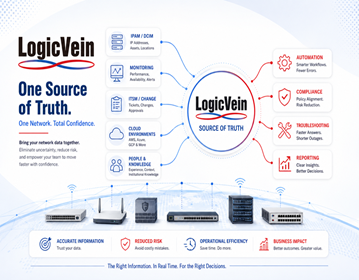
And because netLD's config backup, compliance checks, and audit trail run on the same platform as ThirdEye's monitoring, teams aren't stitching together the fragmented, multi-tool alert streams that drive fatigue in the first place.
The result isn't a faster triage queue. It's a shorter one.
Final Takeaway
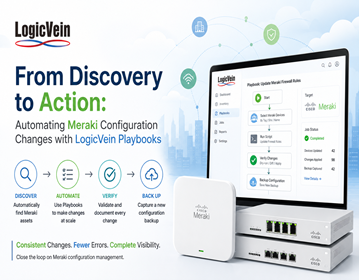
With LogicVein, you don’t just react to changes — you control them.
Watch our series of videos here or see all our features here.
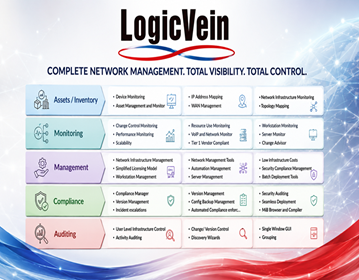
With its combination of discovery, monitoring, compliance, and automation, LogicVein transforms how IT teams manage complex network environments.
Whether you’re looking to reduce manual work, improve network reliability, or gain better visibility into device configurations, LogicVein will provide you the tools you need—all in a single platform.
Ready to see LogicVein in action? Request a Demo and discover how you can simplify operations, improve reliability, and gain full network visibility.