
How LogicVein Delivers Unified IT Operations Management
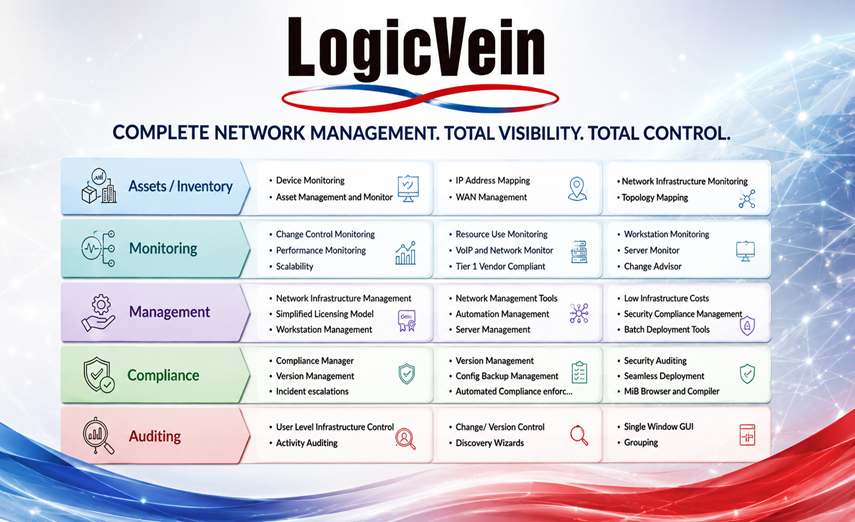
Modern IT operations are no longer about simply knowing whether a router, switch, server, or application is online. Organizations need to understand what they have, how it is performing, what has changed, whether it complies with policy, and who made those changes. The diagram above organizes these requirements into five fundamental areas:
Assets & Inventory → Monitoring → Management → Compliance → Auditing
LogicVein supports this operational model by bringing these capabilities together through ThirdEye, Net LineDancer, and ThirdEye Suite. Instead of forcing network teams to work across disconnected monitoring, configuration, automation, compliance, and auditing systems, LogicVein provides a platform where these functions can work together. The result is a more complete approach to IT Operations Management (ITOM).
1. Assets & Inventory: Establishing the Foundation
Every IT operations strategy begins with a basic question:
What is actually on our network?
That question becomes increasingly difficult to answer as environments expand across data centers, branch offices, cloud infrastructure, remote locations, and multiple network vendors. LogicVein helps organizations discover and maintain visibility into the infrastructure they manage.
Device Discovery and Inventory
LogicVein can discover network devices and collect information that helps administrators understand the infrastructure under management. Rather than treating inventory as a static spreadsheet, device information becomes part of the operational platform. Once a device is known to LogicVein, that information can be used for other functions such as:
- Device monitoring
- Configuration backup
- Network topology
- Automation
- Compliance analysis
- Configuration change tracking
- Reporting
- Incident investigation
This creates an important relationship between inventory and operations.
IP and Network Visibility
LogicVein also provides network teams with information that helps them understand how devices and infrastructure relate to each other. When combined with monitoring and topology capabilities, administrators can move beyond a simple list of devices and begin building an operational picture of the network. The objective is to establish a reliable foundation: Know what you have before trying to manage it.
2. Monitoring: Understanding What Is Happening
Once infrastructure has been identified, the next question is:
Is everything operating as expected?
LogicVein ThirdEye provides the monitoring capabilities needed to observe network infrastructure, systems, resources, and services. This can include monitoring areas such as:
- Device availability
- Network performance
- Interface utilization
- CPU and memory utilization
- Network resources
- Servers
- Workstations
- Network services
- VoIP infrastructure
- SNMP-based metrics
- Events and incidents
Instead of monitoring existing in isolation, LogicVein can connect operational events with information about the underlying device. That context becomes extremely valuable during troubleshooting. For example, if ThirdEye detects an interface problem, the administrator may need more than the alert itself. They may also want to know:
- What device is affected?
- What interfaces or devices are connected to it?
- Has its configuration recently changed?
- Is there a configuration backup?
- Does the current configuration comply with policy?
Those questions begin connecting monitoring to the rest of the LogicVein platform.
Topology Adds Context to Monitoring
A list of alarms does not always explain the impact of a network problem. Topology helps provide that context. LogicVein can help administrators visualize network relationships so that infrastructure is not viewed simply as individual devices. Consider a switch failure. Knowing that the switch is unavailable is useful. Knowing that the switch connects several downstream devices, servers, or network segments provides much greater operational context.
This transforms monitoring from:
"Device X is down."
into:
"Device X is down, and these portions of the infrastructure may be affected."
That difference can significantly improve troubleshooting and incident response.
3. Management: Turning Visibility Into Action
Monitoring tells administrators that something has happened. Management gives them the tools to do something about it. LogicVein Net LineDancer provides extensive Network Configuration and Change Management capabilities, while ThirdEye Suite brings monitoring and management together into a broader operational environment.
Capabilities can include:
- Configuration management
- Configuration backup
- Configuration comparison
- Version management
- Network automation
- Change management
- Device grouping
- Bulk operations
- Playbook-driven workflows
- Device configuration deployment
This allows network teams to move from simply observing infrastructure to actively controlling it.
Configuration Backup and Version Management
One of the most important responsibilities of network management is maintaining reliable copies of device configurations. LogicVein can automatically retrieve and maintain configuration backups from supported network devices. That creates a historical configuration record. When something changes, administrators can compare versions and determine exactly what was modified. For example:
Yesterday
interface GigabitEthernet1/0/24 switchport access vlan 100
Today
interface GigabitEthernet1/0/24 switchport access vlan 200
Instead of trying to determine why connectivity changed by manually inspecting the device, administrators can quickly identify the configuration difference. Configuration history therefore becomes part of troubleshooting.
Automation Through LogicVein Playbooks
Many network operations tasks are repetitive. Administrators may need to:
- Change VLAN assignments
- Update interface settings
- Deploy configuration commands
- Modify banners
- Collect information
- Validate configurations
- Perform compliance remediation
- Execute commands across groups of devices
Performing these tasks manually becomes increasingly risky as the environment grows. LogicVein Playbooks provide a way to automate these workflows. A workflow can define the steps that should occur, the devices against which those steps should run, and the logic controlling the operation. Instead of an administrator manually performing the same procedure hundreds of times, the process becomes repeatable. This improves both efficiency and consistency.
4. Compliance: Continuously Validating the Network
Managing configurations answers:
What configuration is running?
Compliance answers a different question:
Is that configuration what the organization expects?
LogicVein can evaluate network configurations against policies defined by the organization. These policies can represent:
- Internal configuration standards
- Security requirements
- Operational best practices
- Required configuration statements
- Prohibited configuration statements
- Vendor recommendations
This allows network teams to identify devices that have drifted away from their expected configuration.
From Detection to Remediation
Finding a compliance problem is useful. Correcting it is better. LogicVein's combination of compliance capabilities and automation allows organizations to build workflows where compliance findings can lead to remediation processes. Conceptually, the workflow becomes:
Configuration Backup
↓
Compliance Analysis
↓
Violation Detected
↓
Remediation Workflow
↓
Configuration Updated
↓
Configuration Revalidated
This moves compliance away from periodic manual reviews and toward a more continuous operational process.
Configuration Backups Strengthen Compliance
Configuration backup is also an important part of compliance.
Suppose an auditor asks:
"Was this device configured according to policy six months ago?"
Looking only at today's configuration cannot answer that question. Configuration history can. Maintaining versions provides organizations with historical evidence showing how network configurations changed over time. That makes configuration management an important foundation for both compliance and auditing.
5. Auditing: Understanding Who Changed What
Network environments constantly change. Engineers make configuration modifications. Automation executes commands. Software is upgraded. Policies are updated. Devices are added and removed. When something goes wrong, organizations need to reconstruct what happened. LogicVein provides auditing and change-tracking capabilities that help answer questions such as:
- What changed?
- When did it change?
- Which device changed?
- What was the previous configuration?
- What is the current configuration?
- Who initiated an activity?
- Was the change expected?
- Does the new configuration comply with policy?
This creates accountability around infrastructure management.
Change Advisor: Connecting Changes With Network Behavior
One particularly valuable relationship is the connection between configuration changes and network events. Imagine that network performance begins degrading at 10:15 AM. Traditional monitoring may tell the operations team when the problem started. Configuration management may separately show that a device configuration changed. When those two pieces of information can be viewed together, administrators gain an important troubleshooting clue:
10:05 AM — Configuration changed
↓
10:15 AM — Network performance degraded
That correlation can dramatically reduce the time required to identify the cause of an incident. LogicVein's Change Advisor capabilities are designed to help provide this type of operational context.
The Power Comes From Connecting Everything
The real value of the model shown in the diagram is not any single feature. It is the relationship between the layers. Consider a typical LogicVein workflow.
Step 1 — Discover
LogicVein discovers a network device and adds it to the managed inventory.
Step 2 — Monitor
LogicVein begins monitoring availability, performance, interfaces, and other operational metrics.
Step 3 — Protect
LogicVein retrieves and maintains configuration backups.
Step 4 — Detect Changes
LogicVein identifies when the device configuration changes.
Step 5 — Validate
Compliance policies evaluate whether the configuration meets organizational standards.
Step 6 — Automate
LogicVein Playbooks can help administrators perform standardized configuration or remediation workflows.
Step 7 — Audit
The organization maintains the history needed to understand what changed and how the infrastructure reached its current state.
That creates a continuous operational lifecycle:
Discover → Monitor → Manage → Protect → Validate → Automate → Audit
ThirdEye Suite Brings the Model Together
This is where LogicVein ThirdEye Suite becomes particularly important. ThirdEye provides network monitoring and operational visibility. Net LineDancer provides network configuration, change, backup, automation, and compliance capabilities. ThirdEye Suite brings these disciplines together into a more unified operational experience. Instead of treating Network Performance Monitoring and Network Configuration Management as completely separate activities, teams can approach them as related parts of the same operational workflow.
That means an administrator investigating an incident is not limited to asking:
"What is happening?"
They can also ask:
"What changed?"
And then:
"Does that change comply with our standards?"
And ultimately:
"What should we do about it?"
That is a much more powerful operational model.
Reducing the Cost and Complexity of Tool Sprawl
Many organizations already have products capable of performing the individual functions shown in the diagram. The challenge is that they may require a different product for almost every function.
- One platform for monitoring.
- Another for configuration backup.
- Another for compliance.
- Another for automation.
- Another for topology.
- Another for change auditing.
The organization then has to manage all of those products. That means additional:
- Licensing
- Servers and infrastructure
- Databases
- Integrations
- Upgrades
- Security reviews
- Training
- Vendor relationships
- Administrative overhead
Consolidation can therefore provide value beyond licensing costs. It can simplify operations. LogicVein helps organizations consolidate many of these functions into a common platform while providing a consistent view of network operations.
One Platform, Five Critical IT Operations Disciplines
The diagram can ultimately be summarized in five questions.
Assets & Inventory
What do we have?
LogicVein provides discovery, inventory, device information, and network visibility.
Monitoring
What is happening?
ThirdEye monitors network infrastructure, devices, resources, performance, and incidents.
Management
What can we do about it?
Net LineDancer and LogicVein automation provide configuration management, backups, change control, Playbooks, and deployment capabilities.
Compliance
Does the network meet our standards?
LogicVein evaluates configurations against defined policies and helps identify configuration drift and violations.
Auditing
What happened, what changed, and who was responsible?
Configuration history, activity tracking, version management, and Change Advisor provide the context required to investigate and document changes.
From Multiple Tools to One Operational Strategy
The objective of IT Operations Management should not be to collect more tools. It should be to give IT and network teams the information and control they need to operate infrastructure reliably. The model shown in the diagram demonstrates how broad that responsibility has become. Inventory alone is not enough. Monitoring alone is not enough. Configuration backup alone is not enough. Compliance alone is not enough. Automation alone is not enough. Each becomes significantly more valuable when connected to the others. LogicVein brings these capabilities together through ThirdEye, Net LineDancer, and ThirdEye Suite, helping organizations establish a continuous operational process built around visibility, monitoring, control, compliance, automation, and accountability. The result is a platform that helps answer the questions every network operations team eventually needs to answer:
What do we have?
What is happening?
What changed?
Are we compliant?
Can we fix it efficiently?
And can we prove exactly what happened?
That is how LogicVein supports the complete IT Operations Management lifecycle.
Final Takeaway
With LogicVein, you don’t just react to changes — you control them.
Watch our series of videos here or see all our features here.
With its combination of discovery, monitoring, compliance, and automation, LogicVein transforms how IT teams manage complex network environments.
Whether you’re looking to reduce manual work, improve network reliability, or gain better visibility into device configurations, LogicVein will provide you the tools you need—all in a single platform.
Ready to see LogicVein in action? Request a Demo and discover how you can simplify operations, improve reliability, and gain full network visibility.