
Why Network Teams Need a Source of Truth
Modern networks never stop changing. Devices are added and removed, configurations are updated, interfaces are reassigned, VLANs shift, software gets upgraded, and cloud resources appear and disappear. Engineers make emergency fixes, automation platforms push changes, and sometimes someone logs into a device and makes a quick adjustment that never gets documented.
The problem isn't that networks change — it's that our understanding of the network doesn't always change with them. When documentation, spreadsheets, diagrams, monitoring systems, and configuration backups all tell slightly different stories, network teams are left asking a surprisingly hard question: which version of the network is actually correct? That's why network teams need a reliable source of truth.
What Is a Network Source of Truth?
A source of truth is the authoritative representation of the network and its current state. Depending on the organization, that may include:
- Network devices and inventory
- Device configurations
- IP addresses and subnets
- VLANs
- Interfaces
- Hardware and software versions
- Network topology
- Device relationships
- Configuration history
- Compliance status
- Operational metadata
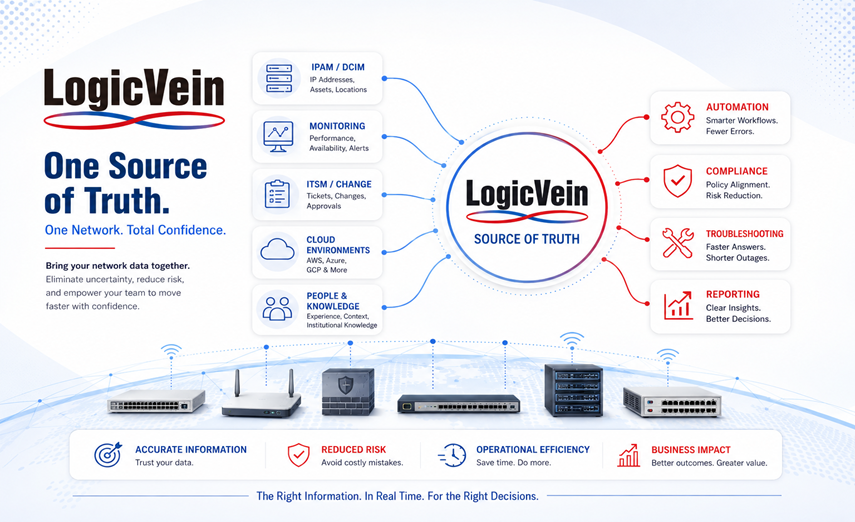
The concept sounds simple. The reality usually isn't. Most organizations already have this information — it's just scattered across multiple systems. An IPAM platform knows about addresses. A monitoring platform knows whether devices are responding. A configuration management system holds device configurations. A spreadsheet tracks equipment. A diagram shows the topology. A ticketing system documents changes. And an experienced network engineer often knows things that aren't documented anywhere. Each system holds part of the truth. The challenge is knowing which one to trust.
The Real Problem Is Conflicting Information
Imagine an engineer gets an alert about a problem with a network device. The monitoring system confirms the device exists. IPAM shows one IP address; the documentation shows another. The network diagram hasn't been updated in six months. The configuration backup is three weeks old. And the engineer who made the last change is on vacation. Before troubleshooting even begins, someone has to figure out what the network is supposed to look like. That uncertainty creates real operational friction — a five-minute troubleshooting task can quickly turn into a 30-minute investigation simply because nobody's sure which information is accurate. Multiply that across hundreds or thousands of devices, dozens of engineers, and a full year of operations, and the cost adds up fast.
The Business Cost of Not Knowing What Is True
A source of truth might sound like a technical requirement, but not having one creates real business problems — and they show up in several ways.
Longer outages. In the first few minutes of an outage, engineers need to know what changed, which devices are affected, what the configuration should look like, what dependencies exist, and what the last known-good state was. When that information has to be pieced together manually across several systems, troubleshooting slows down. Mean Time to Repair (MTTR) climbs — not because the technical problem is hard, but because engineers spend precious time just establishing the facts. A trustworthy source of truth removes that uncertainty.
Increased change risk. Every network change carries some risk, and that risk grows sharply when engineers start from incomplete or outdated information. Say an engineer believes a device is running one configuration, but the device has actually changed since the last backup. Automation then pushes an update based on that outdated assumption. The automation itself may run flawlessly — the result can still be wrong. This points to one of the most important principles in network automation: automation is only as reliable as the data driving it. Automating on bad data doesn't eliminate mistakes; it accelerates them.
Wasted engineering time. Skilled network engineers are expensive, yet many organizations still have them spending significant time on basic information gathering — logging into devices to check configurations, comparing spreadsheets, digging through ticket histories, manually updating diagrams, or asking around to see if anyone remembers why something was configured a certain way. Individually these tasks take minutes; collectively they consume hundreds or thousands of engineering hours a year. A reliable source of truth flips that equation — instead of spending time discovering the state of the network, engineers can spend it managing and improving it.
Knowledge tied to individuals. Nearly every network team has someone who "knows the network" — why a routing policy exists, which switch was swapped out three years ago, which configuration should never be touched, which undocumented exceptions matter. That experience is valuable, but it's also a risk. People take vacations, change roles, and leave companies. When critical knowledge lives mainly in someone's head, the organization doesn't actually own it. A source of truth helps turn institutional knowledge into organizational information.
Source of Truth Is the Foundation of Automation
Most organizations want to automate more of their network operations — provisioning, configuration changes, compliance remediation, backups, software upgrades, incident response. But automation raises an important question: what information does it actually trust? If an automation workflow needs to update 100 switches, which 100? Which software versions are they running? Which configuration template applies? Which interfaces should change, and which devices should be excluded? Without reliable data behind those decisions, automation becomes a liability rather than an asset. A source of truth supplies the trusted information automation needs to act with confidence. The relationship looks something like this:
Network → Source of Truth → Validation → Automation → Network
The network provides live operational data. The source of truth maintains the authoritative record. Automation uses that record to make controlled changes. The network is then validated again to confirm that intended and actual state still align — creating a feedback loop rather than a one-way process.
Intended State vs. Actual State
One of the most useful concepts in modern network management is the distinction between intended state and actual state. The intended state is what the network should look like; the actual state is what it does look like. In principle, the two should match — but networks drift. An emergency configuration change sticks around longer than planned. A troubleshooting command quietly becomes permanent. A security setting gets modified. A VLAN gets added. An interface description changes. A temporary routing adjustment never gets removed. Bit by bit, the network moves away from its intended state — a phenomenon known as configuration drift. A strong source-of-truth strategy makes that drift visible. Instead of only asking "What is the configuration?", network teams can ask the far more useful question: "Is the network configured the way we expect it to be?"
A Source of Truth Should Not Become Another Data Silo
Creating another database doesn't automatically create a source of truth. If engineers have to manually maintain yet another system, the organization risks producing just another outdated version of the network. The better approach is integration — letting network information move between the systems already responsible for managing it:
IPAM ↔ Network Management ↔ ITSM ↔ Automation
Each platform can remain authoritative for what it does best. IPAM stays authoritative for IP addressing, a configuration management platform for device configurations, an ITSM platform for change records. The goal isn't to force everything into a single database — it's to create a consistent operational truth across the environment.
The Network Itself Is Part of the Truth
Documentation describes the network. The network itself tells you what actually exists. That's what makes discovery, configuration backup, monitoring, and inventory collection essential parts of a source-of-truth strategy. Network teams should continuously compare what's documented against what's actually discovered in the environment. If documentation lists 4,850 devices but discovery finds 5,012, that gap matters. If IPAM shows one address while a device reports another, that matters. If the approved configuration says one thing while the running configuration says something else, that matters too. These aren't just documentation gaps — they can represent real operational and security risk.
From Source of Truth to System of Action
Having accurate information is valuable. Acting on it is even more valuable. A mature network management strategy progresses through five stages:
Know → Detect → Decide → Act → Verify
Know what devices and configurations exist. Detect when something changes or drifts from policy. Decide whether that difference is expected or needs action. Act, manually or through automation. Verify that the network has returned to its expected state. This is what turns a source of truth from passive documentation into an active part of network operations.
Where LogicVein Fits
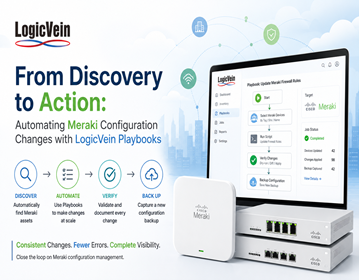
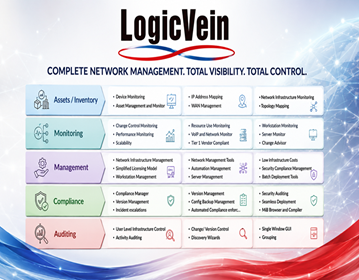
A network source of truth becomes far more valuable when it's connected directly to network operations. LogicVein helps organizations build that operational view by combining network discovery, inventory, configuration management, monitoring, compliance, automation, and change history in one platform. Instead of relying solely on manually maintained records, network teams can continuously pull information from the infrastructure itself. Configuration backups provide a historical record of device state. Discovery identifies devices and their relationships. Compliance checks flag configurations that deviate from organizational standards. Monitoring delivers visibility into operational state. Playbooks give teams a mechanism for taking controlled action. And integrations with platforms like IPAM, DCIM, and ITSM keep information synchronized across the broader IT environment.
The result isn't just better documentation — it's a more reliable operational picture of the network.
The Business Outcome: Less Uncertainty
The value of a network source of truth ultimately comes down to one word: certainty. When engineers trust their network information, decisions happen faster, troubleshooting speeds up, changes get safer, automation becomes more reliable, and audits get easier. Knowledge becomes less dependent on any one person, and teams spend less time figuring out what happened and more time improving what happens next. For business leaders, that means reduced operational risk, better use of engineering resources, shorter outages, and greater confidence in automation initiatives. For network engineers, it means something just as valuable: when you need to know what's happening in the network, you know exactly where to look.
Your Network Is Already Telling You the Truth
Every device in your environment is constantly providing information about its configuration, status, relationships, and behavior. The challenge is capturing that information, keeping it current, validating it, and putting it to use. Spreadsheets and static diagrams can document a network. A true source of truth does more — it shows you what the network looked like yesterday, what it looks like today, what it's supposed to look like, and what changed in between. As networks grow larger, more distributed, and more automated, knowing the truth about your infrastructure isn't just good network management. It's the foundation for operating the network with confidence.
Final Takeaway
With LogicVein, you don’t just react to changes — you control them.
Watch our series of videos here or see all our features here.
With its combination of discovery, monitoring, compliance, and automation, LogicVein transforms how IT teams manage complex network environments.
Whether you’re looking to reduce manual work, improve network reliability, or gain better visibility into device configurations, LogicVein will provide you the tools you need—all in a single platform.
Ready to see LogicVein in action? Request a Demo and discover how you can simplify operations, improve reliability, and gain full network visibility.