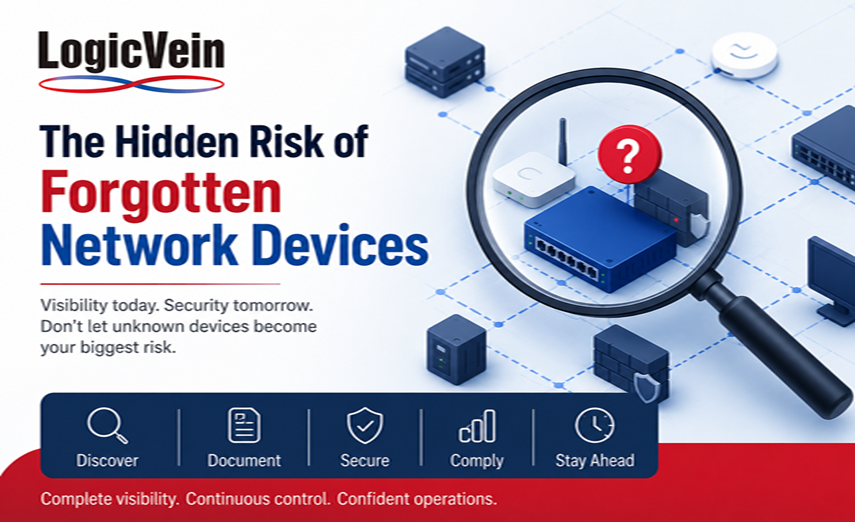

The Hidden Risk of Forgotten Network Devices: Why Visibility Is Your First Line of Defense
When network outages happen, most organizations immediately look to their core infrastructure. Was it the firewall? The data center switch? The WAN connection?
Surprisingly often, the real culprit is something much less obvious: a device that everyone forgot existed.
An old switch installed in a warehouse. A router left behind after a branch office relocation. A wireless access point deployed for a temporary project. A test firewall that was never removed from production.
These forgotten devices don't just create clutter—they create security vulnerabilities, compliance gaps, operational headaches, and unexpected outages.
For organizations managing hundreds or thousands of network devices, maintaining complete visibility isn't optional. It's one of the most important aspects of a healthy network.
The "Set It and Forget It" Problem
Every IT department has them.
Projects come and go, employees leave, acquisitions happen, and temporary solutions become permanent. Over time, equipment gets deployed without proper documentation or ownership.
Common examples include:
- Switches installed during office expansions
- Temporary wireless networks created for events
- Backup internet routers that remain connected
- Legacy firewalls left online after migrations
- Lab equipment accidentally connected to production
- UPS units, PDUs, and environmental monitors with network interfaces
- Printers and IoT devices with outdated firmware
- Remote office equipment nobody has logged into for years
Because these devices continue functioning, they rarely attract attention until they fail—or worse, become an entry point for attackers.
Documentation Is Only Accurate for a Moment
Most organizations invest significant time creating network diagrams and inventory spreadsheets.
The problem is that networks evolve constantly.
Every one of these changes can make documentation obsolete:
- Hardware replacements
- IP address changes
- VLAN modifications
- New branch offices
- Cloud migrations
- Emergency maintenance
- Vendor upgrades
- Staff turnover
Even the best documentation represents a snapshot in time. Without continuous updates, it quickly becomes disconnected from reality.
When engineers rely on outdated information during an outage, troubleshooting slows dramatically.
Unknown Devices Create Security Blind Spots
Security teams spend enormous effort hardening firewalls and patching servers, but forgotten infrastructure often escapes routine maintenance.
An unmanaged device may have:
- Default credentials still enabled
- Unsupported firmware with known vulnerabilities
- Weak SNMP community strings
- Expired certificates
- Open management interfaces exposed to internal networks
- Disabled logging
- Misconfigured access control lists
Because nobody is actively monitoring these systems, vulnerabilities can remain undetected for years.
Attackers don't necessarily target the newest equipment—they look for the easiest path into an environment.
A forgotten switch in a remote office can be just as dangerous as an unpatched firewall.
Configuration Drift Happens Quietly
Even documented devices can become liabilities when configurations slowly drift away from approved standards.
Someone enables Telnet for troubleshooting. A temporary user account never gets removed. SNMP settings change. A routing statement is added during an emergency.
Months later, nobody remembers why those changes exist.
Over time, networks become inconsistent, making future troubleshooting and auditing increasingly difficult.
Without automated comparison against known-good configurations, these changes often go unnoticed until they contribute to an outage.
Compliance Requires Complete Visibility
Whether your organization follows internal security standards or industry regulations, compliance depends on knowing what actually exists.
You can't secure what you don't know about.
An incomplete inventory means:
- Devices may never receive firmware updates
- Configuration policies cannot be enforced
- Security baselines become unreliable
- Audit reports contain gaps
- Backup schedules miss critical infrastructure
During an audit, discovering previously unknown devices raises immediate questions about governance and operational controls.
Maintaining visibility isn't simply good practice—it demonstrates mature network management.
Incident Response Starts with Inventory
Imagine an outage affecting a remote location.
The first questions engineers ask are usually:
- What devices are installed there?
- Which switch connects this circuit?
- Who manages that router?
- Has anything changed recently?
- Do we have the latest configuration backup?
If the answers require digging through spreadsheets, old Visio diagrams, or emailing former employees, valuable recovery time is lost.
An accurate inventory dramatically reduces mean time to resolution because engineers can immediately focus on solving the problem instead of identifying the infrastructure.
Discovery Should Be Continuous, Not Annual
Many organizations treat discovery as a deployment exercise.
They scan the network once, populate an inventory database, and move on.
Unfortunately, networks don't stay static.
Every month brings:
- New equipment
- Retired hardware
- Address changes
- Interface modifications
- Software upgrades
- Topology changes
Continuous discovery allows organizations to identify:
- Newly connected devices
- Equipment that disappeared unexpectedly
- IP conflicts
- Duplicate hostnames
- Unauthorized hardware
- Inventory discrepancies
Instead of assuming the network hasn't changed, teams can verify it automatically.
Visibility Should Include More Than Device Names
Simply knowing a device exists isn't enough.
A truly useful inventory should answer operational questions such as:
Ownership
Who is responsible for this device?
Configuration Status
When was the last successful backup?
Compliance
Does it meet organizational standards?
Firmware
Is it running a supported software version?
Monitoring
Is it actively being monitored?
Change History
What changed, and when?
Business Impact
Which applications or locations depend on it?
This context transforms inventory from a static asset list into an operational intelligence platform.
How LogicVein Eliminates Network Blind Spots
LogicVein is designed to help organizations maintain a living, continuously updated view of their network infrastructure. Instead of relying on outdated spreadsheets or manually maintained diagrams, LogicVein provides the visibility and automation needed to keep inventory accurate and actionable.
Automated Device Discovery
Continuously discover devices across multi-vendor environments and identify newly connected hardware before it becomes a blind spot.
Configuration Backups
Schedule automatic backups of routers, switches, firewalls, and other network devices so recovery is fast and reliable when failures occur.
Change Detection
Instantly compare current configurations against previous versions to identify unexpected or unauthorized changes.
Compliance Monitoring
Verify that devices meet internal standards and regulatory requirements by automatically checking configurations against predefined policies.
Centralized Inventory
Maintain detailed information about hardware models, software versions, serial numbers, interfaces, IP addresses, and ownership in a single platform.
Reporting and Auditing
Generate reports for security reviews, compliance audits, lifecycle planning, and operational management without manually collecting data.
By combining discovery, backup, compliance, and change management, LogicVein helps transform inventory from a static spreadsheet into a continuously updated source of truth.
The Cost of Ignoring Forgotten Devices
The impact of unmanaged infrastructure extends beyond security.
Organizations may experience:
- Longer outage resolution times
- Failed compliance audits
- Duplicate or conflicting configurations
- Increased operational costs
- Unnecessary hardware purchases
- Unexpected security exposures
- Inaccurate capacity planning
What seems like a harmless forgotten switch can become the root cause of a major incident months or years later.
Building a Culture of Visibility
The most successful network teams don't wait for outages to discover problems.
They invest in processes that continuously answer three simple questions:
- What devices do we have?
- What state are they in?
- Have they changed?
When those answers are always available, troubleshooting becomes faster, compliance becomes easier, and planning becomes more accurate.
Visibility isn't a project that gets completed once. It's an ongoing operational discipline.
Final Thoughts
Every network contains forgotten devices. The difference between resilient organizations and vulnerable ones is whether those devices remain hidden.
Continuous discovery, automated configuration management, and ongoing compliance monitoring ensure that no switch, router, firewall, or appliance quietly slips into obscurity.
With LogicVein, IT teams can replace outdated inventories and scattered documentation with a dynamic, accurate view of the entire network—helping them reduce risk, accelerate troubleshooting, and stay ahead of change.
Because in network management, the biggest threat isn't always the device that's failing.
Sometimes, it's the one nobody remembers is there.
Final Takeaway
With LogicVein, you don’t just react to changes — you control them.
Watch our series of videos here or see all our features here.
With its combination of discovery, monitoring, compliance, and automation, LogicVein transforms how IT teams manage complex network environments.
Whether you’re looking to reduce manual work, improve network reliability, or gain better visibility into device configurations, LogicVein will provide you the tools you need—all in a single platform.
Ready to see LogicVein in action? Request a Demo and discover how you can simplify operations, improve reliability, and gain full network visibility.