
LogicVein vs. In-House Network Management Tools
Every network team reaches a point where spreadsheets, scripts, and disconnected monitoring tools stop being enough. The challenge is rarely obvious at first. A few Python scripts automate backups. A homegrown inventory database tracks devices. Monitoring is spread across multiple platforms. Configuration standards exist, but enforcement depends on engineers remembering to check them. Initially, this approach works. As networks grow, however, complexity grows faster than the tools designed to manage it. Organizations eventually face a critical decision:
-
Continue investing in internally developed solutions
-
Purchase a collection of specialized point products
-
Adopt an integrated network management and automation platform
This is where LogicVein differentiates itself.
The In-House Solution Trap
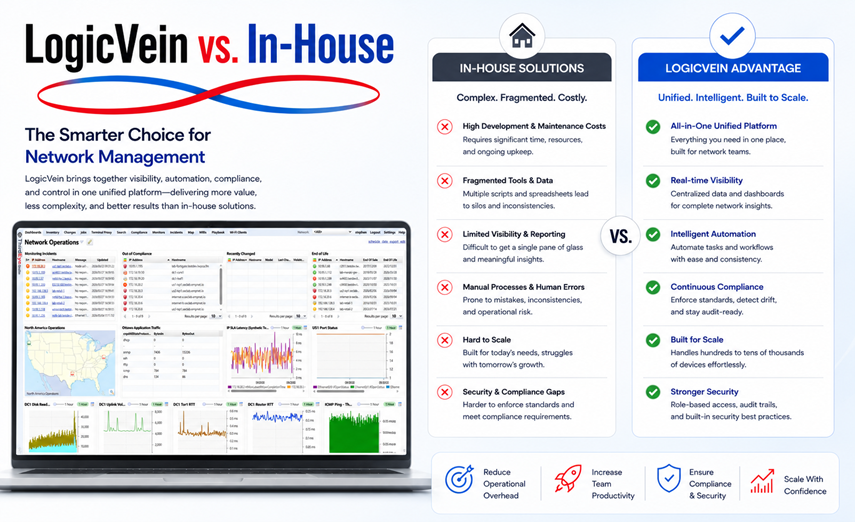
Many organizations believe building their own platform provides maximum flexibility. At first glance, this seems reasonable. An engineer creates a backup script. Another builds a configuration parser. A developer creates a dashboard. Over time, these components become business-critical. Then reality arrives.
Key Challenges of Internal Tools
Knowledge Concentration
The person who wrote the script becomes the only person who understands it. If that individual changes roles, leaves the company, or becomes unavailable, the organization inherits technical debt.
Maintenance Never Ends
Network vendors release new operating systems. Authentication methods change. APIs evolve. Security requirements increase. Every internal tool requires ongoing maintenance simply to continue functioning.
Lack of Integration
Most internal tools solve one problem:
-
Backups
-
Monitoring
-
Compliance
-
Reporting
-
Automation
Few solve all of them together. As a result, teams spend significant time moving data between systems instead of managing the network.
Scaling Becomes Difficult
A script that works for 100 devices often struggles at 1000. A database designed for a lab environment rarely handles enterprise growth gracefully. Many organizations underestimate the engineering effort required to operate a management platform at scale.
The Problem with Point Solutions
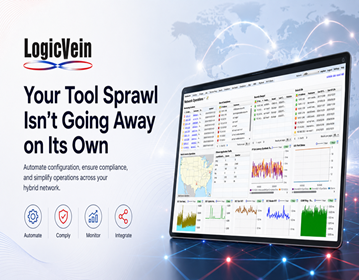
The alternative is purchasing multiple specialized products. One tool handles monitoring. Another handles configuration management. Another manages automation. A fourth provides compliance reporting. While each product may be excellent individually, organizations often encounter new challenges.
Tool Sprawl
Engineers jump between multiple interfaces to complete a single workflow. A configuration issue may require:
-
Identifying the alert in a monitoring platform
-
Investigating inventory data in another tool
-
Reviewing backups in a third system
-
Executing remediation from a fourth platform
The result is slower troubleshooting and fragmented visibility.
Integration Costs
Products rarely integrate as seamlessly as expected. Organizations often spend considerable effort:
-
Writing custom API integrations
-
Maintaining synchronization scripts
-
Mapping inventory between systems
-
Managing duplicate credentials
The software may be commercial, but the integration burden often becomes an internal project.
Why LogicVein Takes a Different Approach
LogicVein was designed around a simple idea:
Network operations should exist in a single workflow rather than across multiple disconnected tools.
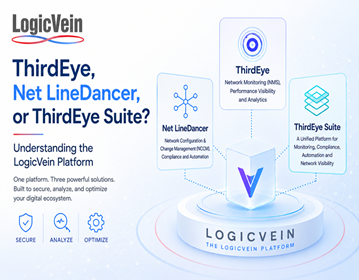
Instead of treating monitoring, automation, compliance, and configuration management as separate disciplines, LogicVein unifies them.
Centralized Device Intelligence
Inventory, topology, credentials, backups, monitoring, and automation all operate against the same device database. This eliminates synchronization challenges that commonly occur when multiple products are stitched together.
Automation Built for Network Engineers
Many automation platforms assume users are software developers. LogicVein focuses on network engineers. Playbooks allow teams to automate workflows without building a custom automation framework from scratch.
Examples include:
-
Interface deployment
-
VLAN provisioning
-
Configuration standardization
-
Compliance remediation
-
Device onboarding
-
Bulk operational changes
Automation becomes accessible to operational teams instead of requiring dedicated development resources.
Compliance That Goes Beyond Auditing
Many solutions identify configuration issues. LogicVein helps organizations both detect and remediate them.
Teams can:
-
Define standards
-
Continuously validate devices
-
Identify drift
-
Trigger corrective actions
This transforms compliance from a periodic audit activity into a continuous operational process.
Designed for Enterprise Scale
Networks continue growing. Management platforms must grow with them. LogicVein supports environments ranging from small deployments to large enterprises managing tens of thousands of devices across distributed locations. Capabilities such as SmartBridge, distributed discovery, and large-scale inventory management allow organizations to expand without redesigning their operational model.
The Real ROI Isn't Software
Many purchasing decisions focus on license costs. The more important metric is operational efficiency.
Consider the time spent:
-
Maintaining custom scripts
-
Troubleshooting integrations
-
Updating homegrown tools
-
Switching between platforms
-
Manually enforcing standards
-
Performing repetitive operational tasks
These costs rarely appear on procurement spreadsheets, but they directly affect productivity, service quality, and risk. The true return on investment comes from reducing operational overhead while increasing consistency.
When an In-House Solution Still Makes Sense
To be fair, not every organization needs a platform like LogicVein. Smaller environments with limited device counts and simple operational requirements may successfully manage their networks with internal tools. However, as complexity increases, organizations typically reach a point where maintaining the management system becomes nearly as difficult as managing the network itself. That is usually the moment when purpose-built platforms begin delivering significant value.
Conclusion
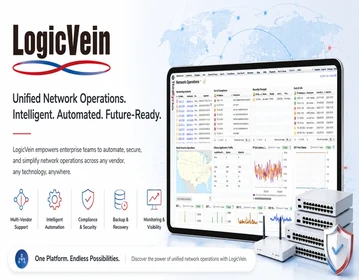
The choice between in-house tools, multiple point products, and an integrated platform ultimately comes down to operational efficiency. Homegrown solutions offer flexibility but require continuous maintenance. Point products provide specialized capabilities but often create integration challenges. LogicVein delivers a unified approach that combines monitoring, configuration management, compliance, inventory, automation, and operational visibility into a single platform. The result is less time managing tools and more time managing the network. Because the goal was never to build a network management platform. The goal was to operate the network effectively.
Final Takeaway
With LogicVein, you don’t just react to changes — you control them.
Watch our series of videos here or see all our features here.
With its combination of discovery, monitoring, compliance, and automation, LogicVein transforms how IT teams manage complex network environments.
Whether you’re looking to reduce manual work, improve network reliability, or gain better visibility into device configurations, LogicVein will provide you the tools you need—all in a single platform.
Ready to see LogicVein in action? Request a Demo and discover how you can simplify operations, improve reliability, and gain full network visibility.