
Building a Sustainable Network Operations Strategy
Every few months another announcement arrives. A familiar switch platform reaches End of Sale. A firewall operating system enters End of Support. A management platform is discontinued. A licensing model changes dramatically. For network engineers, these announcements often create unnecessary pressure. The immediate reaction becomes: "How quickly do we need to replace everything?"
The better question is:
"How do we make sure our operations aren't dependent on any single vendor in the first place?"
The strongest IT organizations aren't the ones with the newest hardware—they're the ones whose operational processes survive hardware refreshes, acquisitions, and vendor strategy changes.
Vendor Lifecycles Are Inevitable
Every manufacturer eventually retires products. That isn't a failure of the vendor—it's simply how technology evolves. What becomes expensive is when your operational workflows are tightly coupled to that vendor's ecosystem.
Examples include:
-
Backups that only work for one manufacturer
-
Monitoring tools designed around proprietary protocols
-
Automation scripts written specifically for one CLI
-
Documentation scattered across multiple vendor portals
-
Compliance processes that change with every hardware refresh
Each replacement project becomes an opportunity to rebuild operational processes from scratch.
The Hidden Cost Isn't Hardware
Replacing equipment is expected. Replacing operational knowledge is not. Network teams spend years developing:
-
Configuration standards
-
Change approval processes
-
Backup policies
-
Compliance rules
-
Automation workflows
-
Monitoring dashboards
If those investments disappear every time hardware changes, organizations end up repeating the same work over and over. The true asset isn't the switch. It's the operational maturity built around it.
Think in Terms of Operations, Not Devices
Modern enterprise networks rarely consist of a single vendor. Instead, they often include:
-
Campus switching
-
Data center fabrics
-
Wireless infrastructure
-
Firewalls
-
SD-WAN
-
Cloud networking
-
Industrial networks
-
Remote offices
Each may come from a different manufacturer. Operations become dramatically simpler when teams standardize how they manage devices, rather than which devices they manage. That means using common processes for:
-
Discovery
-
Inventory
-
Configuration backup
-
Compliance
-
Change management
-
Monitoring
-
Automation
regardless of who manufactured the hardware.
Automation Should Outlive Hardware
One of the biggest advantages of workflow-based automation is longevity. A well-designed automation process focuses on tasks rather than platforms.
For example: Instead of creating a script that configures only one vendor's switches... Create a workflow that:
-
Discovers devices
-
Validates prerequisites
-
Selects vendor-specific logic automatically
-
Applies configuration
-
Verifies success
-
Documents the change
-
Updates compliance status
When new hardware is introduced, only one portion of the workflow changes—not the entire operational process.
Standardize Your Source of Truth
Networks evolve constantly. Without a centralized platform, information ends up spread across:
-
Spreadsheets
-
Wiki pages
-
Vendor portals
-
Configuration archives
-
Ticketing systems
-
Individual engineers' notes
A unified operational platform becomes the consistent source of truth regardless of which vendors are deployed. This consistency reduces onboarding time, improves troubleshooting, and simplifies audits.
Operational Resilience Is a Competitive Advantage
Organizations increasingly evaluate IT teams on operational resilience. Can they:
-
Recover quickly?
-
Perform changes consistently?
-
Pass security audits?
-
Support mergers?
-
Integrate new technologies rapidly?
Those capabilities depend far more on operational tooling than on individual hardware models. Teams with mature automation adapt to change faster because their processes remain consistent.
How LogicVein Helps
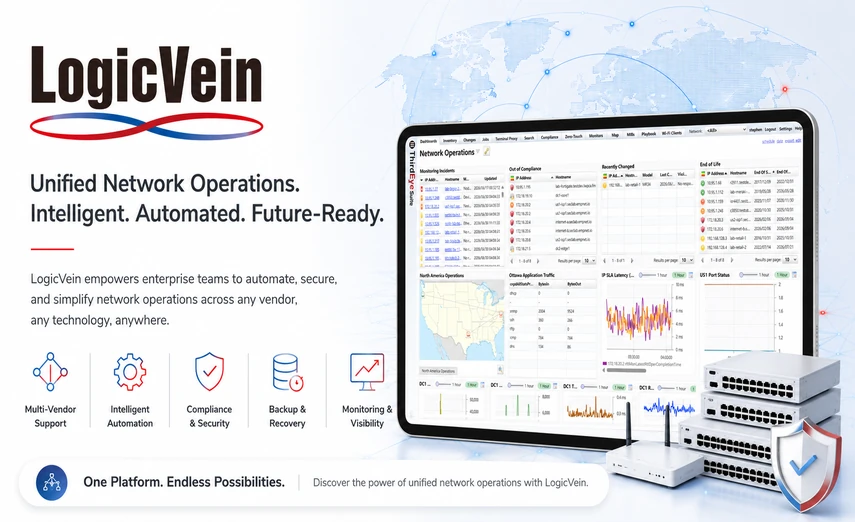
LogicVein is designed around the idea that network operations should remain consistent even as infrastructure changes. With a unified platform, organizations can:
-
Manage multi-vendor environments from a single interface
-
Automate repetitive operational tasks
-
Maintain centralized configuration backups
-
Detect configuration drift automatically
-
Enforce compliance policies consistently
-
Execute repeatable change workflows
-
Monitor devices across diverse environments
-
Scale operations without increasing administrative overhead
Instead of rebuilding operational processes every hardware refresh cycle, teams continue using the same proven workflows while simply adding support for new devices.
Future-Proof Your Operations
Vendor roadmaps will continue to evolve. Product lines will be replaced. Licensing models will change. New technologies will emerge. The organizations that navigate these transitions most successfully aren't necessarily buying equipment faster—they've built operational processes that are independent of any single vendor. That's what future-proofing really means. Not predicting the next platform. Building operations that can support whatever comes next.
Final Thoughts
Hardware has a lifecycle. Operational excellence should not. By investing in standardized automation, centralized management, and vendor-independent workflows, network teams reduce risk, improve efficiency, and remain agile regardless of how the technology landscape changes. With LogicVein, your network management strategy evolves with your infrastructure—not against it.
Final Takeaway
With LogicVein, you don’t just react to changes — you control them.
Watch our series of videos here or see all our features here.
With its combination of discovery, monitoring, compliance, and automation, LogicVein transforms how IT teams manage complex network environments.
Whether you’re looking to reduce manual work, improve network reliability, or gain better visibility into device configurations, LogicVein will provide you the tools you need—all in a single platform.
Ready to see LogicVein in action? Request a Demo and discover how you can simplify operations, improve reliability, and gain full network visibility.