
Why Companies Are Focused on AI: The Strategic Shift Reshaping Business
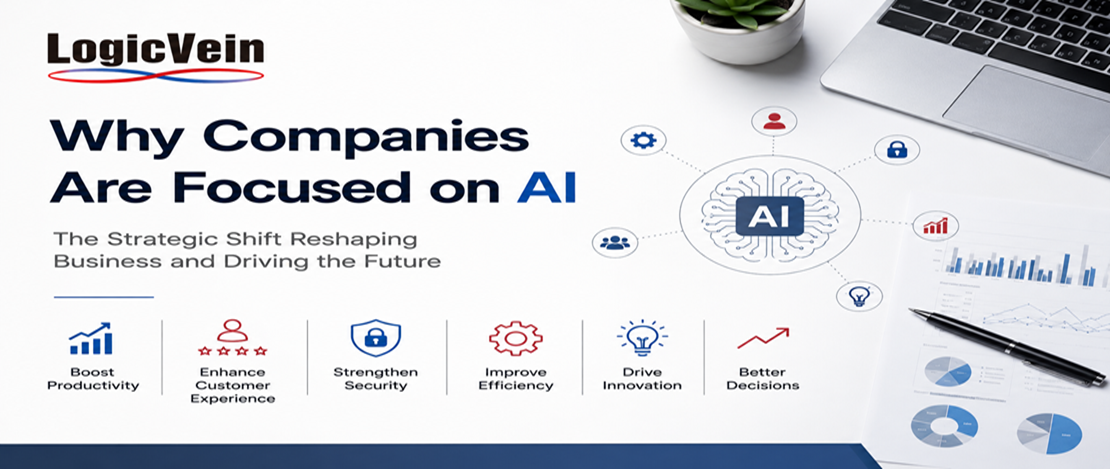
Artificial Intelligence (AI) has become the defining technology investment of the decade. Nearly every boardroom discussion, technology roadmap, and business strategy now includes AI in some form. While the hype surrounding AI can sometimes overshadow reality, the underlying reason for this focus is straightforward: organizations see AI as a way to improve productivity, make better decisions, reduce costs, and create competitive advantages. Much like the rise of the internet in the 1990s and cloud computing in the 2010s, AI is increasingly viewed as a foundational technology that will influence nearly every business process. Organizations that successfully adopt AI stand to gain significant operational and financial benefits, while those that ignore it risk falling behind competitors that can move faster, serve customers better, and operate more efficiently.
The Business Environment Is More Complex Than Ever
Modern organizations face unprecedented challenges:
-
Growing cybersecurity threats
-
Increasing regulatory and compliance requirements
-
Rapidly changing customer expectations
-
Global competition
-
Rising operational costs
-
Expanding volumes of data
-
Shortages of skilled workers in key industries
At the same time, businesses are expected to do more with fewer resources. Teams are managing larger environments, supporting more users, and maintaining increasingly complex technology stacks without proportional increases in staffing. AI offers a potential solution to many of these challenges by helping organizations automate routine work, extract value from data, and improve operational efficiency.
The Productivity Revolution
One of the primary reasons companies are investing in AI is productivity. Studies consistently show that knowledge workers spend substantial portions of their day performing repetitive tasks such as:
-
Searching for information
-
Writing reports
-
Updating documentation
-
Creating presentations
-
Responding to common inquiries
-
Reviewing data
-
Generating summaries
These activities are necessary but often do not directly contribute to innovation or strategic growth. AI-powered tools can dramatically reduce the time required to complete these tasks. A report that previously took several hours to draft can often be generated in minutes. Large datasets can be analyzed in seconds rather than days. Documentation can be created automatically from existing information. The result is not merely faster work—it is a shift in how employees spend their time. Instead of focusing on administrative overhead, teams can dedicate more attention to problem-solving, innovation, customer engagement, and strategic initiatives.
Data Has Become Too Large for Traditional Analysis
Organizations today collect more data than at any point in history. Every customer interaction, network event, transaction, sensor reading, support ticket, configuration change, and security alert generates data. While this information has tremendous potential value, many businesses struggle to transform it into actionable insights. Traditional reporting tools often require users to know what they are looking for before they begin searching. AI changes this model by identifying patterns, anomalies, and trends that humans might miss. Organizations are using AI to:
-
Forecast demand
-
Predict equipment failures
-
Detect fraud
-
Identify customer behavior trends
-
Improve inventory management
-
Optimize logistics
-
Reduce operational risk
Rather than relying solely on historical reporting, businesses can leverage AI to make predictive and proactive decisions.
Competitive Pressure Is Driving Adoption
One of the most powerful forces behind AI adoption is competition. When a competitor uses AI to reduce operating costs, improve service levels, or accelerate product development, others must respond. History provides numerous examples of technology-driven competitive shifts:
-
Organizations that embraced e-commerce gained advantages over traditional retailers.
-
Early cloud adopters reduced infrastructure costs and increased agility.
-
Companies that embraced automation scaled faster than those relying solely on manual processes.
AI is creating a similar dynamic. Businesses are increasingly recognizing that AI is not simply a tool for innovation—it is becoming a requirement for maintaining competitiveness in many industries.
Customer Expectations Have Changed
Customers increasingly expect personalized, immediate, and seamless experiences. Whether interacting with a bank, healthcare provider, retailer, software vendor, or telecommunications company, customers want:
-
Faster responses
-
Personalized recommendations
-
Self-service options
-
Accurate information
-
Consistent experiences across channels
AI helps organizations meet these expectations by enabling:
-
Intelligent chat assistants
-
Personalized marketing campaigns
-
Automated customer support
-
Predictive recommendations
-
Real-time customer insights
Companies that successfully use AI to improve customer experiences often see higher customer satisfaction, stronger retention, and increased revenue opportunities.
AI Is Accelerating Software Development
Software development has become one of the earliest and most visible beneficiaries of AI. Development teams are using AI to:
-
Generate code suggestions
-
Identify bugs
-
Create documentation
-
Review pull requests
-
Generate test cases
-
Explain complex codebases
While AI does not replace skilled developers, it can significantly increase development velocity and reduce time spent on repetitive tasks. Organizations that develop software internally are increasingly using AI to accelerate innovation and improve delivery timelines.
Transforming IT Operations and Infrastructure Management
IT teams face growing complexity. Modern environments often include:
-
On-premises infrastructure
-
Public cloud platforms
-
SaaS applications
-
Hybrid networks
-
Remote workers
-
IoT devices
-
Security tools from multiple vendors
Managing these environments generates massive volumes of operational data. AI is helping IT teams:
-
Identify anomalies before outages occur
-
Reduce alert fatigue
-
Correlate events across systems
-
Predict capacity issues
-
Improve root-cause analysis
-
Automate operational workflows
Instead of reacting to problems after users are affected, organizations can increasingly detect and address issues proactively.
AI and Network Operations
For network teams, AI is becoming particularly valuable as infrastructures grow larger and more distributed. Network engineers frequently deal with:
-
Configuration drift
-
Performance degradation
-
Compliance requirements
-
Device lifecycle management
-
Security vulnerabilities
-
Large-scale troubleshooting
AI-powered network operations can help identify abnormal behavior, analyze configuration changes, prioritize alerts, and surface operational insights more quickly than traditional methods. However, AI is most effective when combined with strong operational visibility. Organizations still require accurate inventory data, configuration backups, compliance validation, and monitoring platforms to provide the data that AI systems analyze. In many cases, AI enhances network management rather than replacing existing operational processes.
Cybersecurity Is a Major Driver
Cybersecurity has become one of the strongest business cases for AI investment. Security teams face:
-
Increasing attack volumes
-
Sophisticated threat actors
-
Expanding attack surfaces
-
Talent shortages
-
Growing compliance requirements
AI helps organizations:
-
Detect suspicious activity
-
Analyze large volumes of security events
-
Prioritize incidents
-
Accelerate investigations
-
Identify unusual behavior patterns
While AI is not a substitute for strong security practices, it can significantly improve detection and response capabilities.
The Workforce Is Changing
Contrary to many headlines, most organizations are not implementing AI solely to replace employees. Instead, businesses are discovering that AI is most effective when augmenting human expertise. Successful organizations typically use AI to:
-
Eliminate repetitive work
-
Improve employee productivity
-
Increase access to information
-
Support decision-making
-
Enhance collaboration
This approach allows employees to focus on higher-value activities that require creativity, judgment, relationship-building, and domain expertise. The future workplace is likely to involve employees working alongside AI systems rather than being replaced by them.
The Economics of AI Are Becoming More Attractive
Several factors have accelerated AI adoption in recent years:
Cloud Infrastructure
Cloud providers have made advanced AI capabilities accessible without requiring organizations to build expensive infrastructure from scratch.
Improved Models
Modern AI systems have become significantly more capable, accurate, and useful than earlier generations.
Lower Barriers to Entry
Businesses can now implement AI solutions without maintaining large teams of data scientists.
Faster Return on Investment
Organizations are increasingly finding measurable ROI through productivity improvements, operational efficiencies, and cost reductions. As implementation costs decrease and benefits become more visible, AI adoption continues to accelerate.
Challenges and Risks Remain
Despite the opportunities, AI adoption is not without challenges. Organizations must address concerns around:
Data Quality
Poor data leads to poor outcomes. AI systems are only as effective as the information they receive.
Security and Privacy
Sensitive information must be protected when using AI systems.
Governance
Organizations need policies governing how AI is used and how decisions are validated.
Compliance
Many industries face strict regulatory requirements regarding data handling and automated decision-making.
Accuracy
AI can generate incorrect or misleading information. Human oversight remains essential.
Change Management
Employees require training and support to effectively integrate AI into daily workflows. Companies that address these challenges proactively are more likely to achieve long-term success.
Why AI Still Needs Operational Visibility
While AI is transforming how organizations analyze information and automate workflows, AI systems are only as effective as the data they receive. Many organizations discover that before AI can deliver meaningful results, they must first solve fundamental operational challenges:
-
Incomplete device inventories
-
Missing documentation
-
Configuration drift
-
Siloed monitoring systems
-
Lack of change visibility
-
Inconsistent compliance validation
-
Poor historical data retention
Without accurate and reliable operational data, AI can produce incomplete, misleading, or inaccurate recommendations. This is especially true within network and infrastructure environments, where a single configuration change can impact performance, security, compliance, and business continuity. Organizations that achieve the greatest value from AI typically begin by establishing strong operational visibility and governance.
How LogicVein Helps Organizations Prepare for AI
LogicVein provides the operational foundation that makes AI initiatives more effective. By continuously collecting, organizing, and maintaining network operational data, LogicVein helps ensure AI systems have access to accurate information about the environment they are analyzing.
Complete Network Visibility
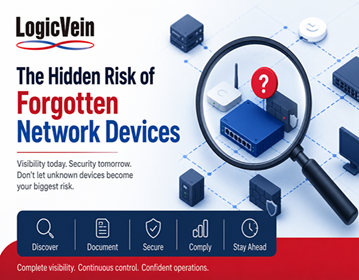
AI cannot analyze what it cannot see. LogicVein automatically discovers and inventories devices across multi-vendor environments, creating a comprehensive view of network infrastructure that can serve as a trusted source of operational data. This visibility helps organizations:
-
Understand what devices exist
-
Identify unmanaged assets
-
Maintain accurate inventories
-
Provide context for AI-driven analysis
Historical Configuration Intelligence
Many AI systems excel at identifying patterns across large datasets. LogicVein continuously backs up device configurations and tracks every change over time, creating a rich historical dataset that can be leveraged to:
-
Understand change history
-
Identify recurring issues
-
Analyze operational trends
-
Correlate incidents with configuration changes
-
Support root cause investigations
Rather than asking AI to interpret isolated snapshots, organizations can provide years of operational history.
Compliance Data for AI Analysis
AI can help identify compliance risks, but only when compliance data exists. LogicVein continuously validates device configurations against organizational policies and standards, generating structured compliance information that can be analyzed by AI systems. This allows organizations to:
-
Prioritize compliance violations
-
Identify recurring policy failures
-
Understand risk trends
-
Accelerate audit preparation
Operational Context for Better AI Decisions
One of the biggest challenges in AI adoption is context. A generic AI platform may understand networking concepts but often lacks visibility into an organization's specific environment. LogicVein provides operational context including:
-
Device inventory
-
Configuration history
-
Compliance status
-
Monitoring information
-
Change records
-
Network topology relationships
This context helps improve the quality and relevance of AI-generated insights.
AI and Automation Are Better Together
Many organizations focus on AI while overlooking automation. In reality, the greatest operational gains often come from combining both. AI can:
-
Analyze information
-
Recommend actions
-
Identify risks
-
Prioritize work
Automation can:
-
Execute changes
-
Collect data
-
Validate compliance
-
Update configurations
-
Generate reports
LogicVein's Playbooks and automation capabilities help organizations move beyond simply identifying problems to actually resolving them. For example:
- AI identifies a configuration compliance issue.
- LogicVein validates the violation.
- A Playbook automatically remediates the configuration.
- Compliance is revalidated.
- Documentation and audit records are updated.
This combination creates a closed-loop operational workflow that significantly reduces manual effort.
The Future of AI in Network Operations
As AI continues to evolve, network teams will increasingly rely on platforms that provide structured, accurate operational data. The organizations that gain the most value from AI will not necessarily be those with the largest AI budgets. They will be the ones with the most reliable operational visibility, governance, and automation capabilities. LogicVein helps build that foundation by delivering:
-
Network discovery and inventory
-
Configuration management and backup
-
Compliance validation
-
Change tracking
-
Monitoring and alerting
-
Automation and remediation workflows
Together, these capabilities create the operational intelligence layer that enables organizations to confidently leverage AI while maintaining control, security, and accountability.
Conclusion: AI Needs a Foundation
AI is becoming a critical business capability, but successful AI initiatives require more than powerful models and advanced algorithms. They require accurate data, operational visibility, governance, and automation. LogicVein helps organizations establish that foundation by providing the visibility and operational intelligence needed to support both today's network operations and tomorrow's AI-driven workflows. The future is not AI replacing network operations teams. The future is AI working alongside skilled engineers, powered by reliable operational data, automated processes, and platforms like LogicVein that transform information into actionable intelligence.
Final Takeaway
With LogicVein, you don’t just react to changes — you control them.
Watch our series of videos here or see all our features here.
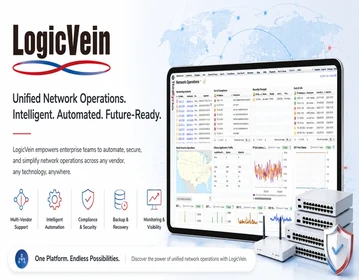
With its combination of discovery, monitoring, compliance, and automation, LogicVein transforms how IT teams manage complex network environments.
Whether you’re looking to reduce manual work, improve network reliability, or gain better visibility into device configurations, LogicVein will provide you the tools you need—all in a single platform.
Ready to see LogicVein in action? Request a Demo and discover how you can simplify operations, improve reliability, and gain full network visibility.