
Most major network outages are not caused by catastrophic hardware failures.
They are caused by small configuration changes.
-
A modified ACL.
-
A forgotten VLAN adjustment.
-
An SNMP setting changed during troubleshooting.
-
A routing policy copied incorrectly to a secondary device.
Individually, these changes seem harmless. Over time, they create something far more dangerous:
Configuration drift.
And despite years of automation progress, configuration drift remains one of the most common — and expensive — operational problems in enterprise networking.
What Is Configuration Drift?
Configuration drift occurs when devices gradually deviate from approved or intended configurations.
This often happens because of:
-
Emergency troubleshooting changes
-
Inconsistent deployment processes
-
Manual CLI edits
-
Temporary fixes that become permanent
-
Vendor syntax differences
-
Human error during maintenance windows
-
Incomplete rollback procedures
The larger the environment becomes, the harder this problem gets to control manually.
A few undocumented changes across dozens of devices can quickly become hundreds of inconsistencies across the network.
Why Drift Is So Dangerous
The problem with drift is not just inconsistency.
It is unpredictability.
Engineers assume devices are configured identically, but operational behavior begins diverging in subtle ways.
That leads to situations like:
-
One switch forwarding traffic differently than another
-
Security policies behaving inconsistently between sites
-
Monitoring tools missing traps or telemetry
-
Redundant paths failing during failover
-
QoS behaving differently across regions
-
Firmware features breaking because of incompatible configs
The worst part?
Teams often do not discover the drift until after an outage occurs.
Manual Detection Does Not Scale
Some organizations still attempt to manage drift using:
-
Spreadsheet tracking
-
Periodic manual audits
-
Random spot checks
-
Text file comparisons
-
Tribal knowledge
This may work temporarily in smaller environments. But modern enterprise networks move too quickly.
Changes happen daily across:
-
Branch offices
-
Data centers
-
Firewalls
-
WAN edge devices
-
Cloud-connected infrastructure
-
SD-WAN deployments
-
Multi-vendor environments
At scale, manual validation simply cannot keep up.
The Operational Cost of Drift
Configuration drift creates more than just technical problems, it impacts operational efficiency everywhere.
Engineers spend additional time:
-
Troubleshooting inconsistent behavior
-
Comparing configurations manually
-
Validating compliance requirements
-
Investigating outages
-
Rebuilding undocumented changes
-
Coordinating between teams
Even worse, drift increases risk during future changes. If baseline configurations are already inconsistent, every new deployment becomes less predictable. That slows down maintenance windows and increases rollback risk.
What Modern Teams Are Doing Differently
High-performing network operations teams now treat configuration drift as a continuously monitored operational condition — not a periodic audit exercise.
Instead of waiting for outages, they continuously:
-
Back up device configurations
-
Compare changes automatically
-
Alert on unauthorized modifications
-
Validate policy compliance
-
Track change history
-
Identify baseline deviations
-
Automate rollback workflows
This creates operational visibility that manual processes cannot realistically provide.
Continuous Drift Detection with NCCM
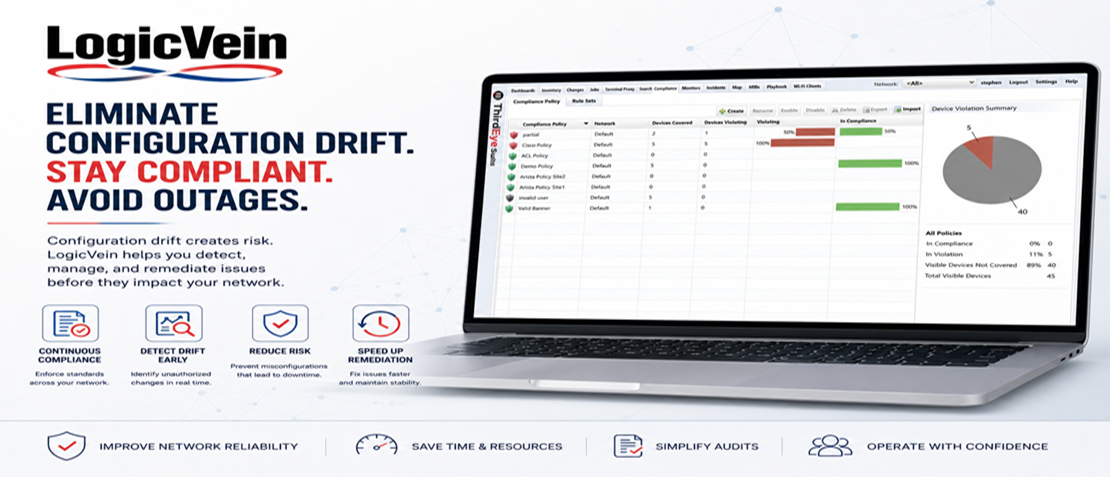
Modern Network Configuration and Change Management (NCCM) platforms like LogicVein's Net LineDancer help organizations continuously detect and manage configuration drift across distributed environments.
Rather than relying on engineers to manually compare configs, the platform automatically:
-
Captures configuration backups
-
Tracks diffs between revisions
-
Detects unexpected changes
-
Generates alerts
-
Maintains audit history
-
Validates compliance policies
-
Supports rollback operations
This dramatically shortens the time between drift introduction and drift detection.
And that timing matters. The faster drift is identified, the lower the operational risk becomes.
Drift Is Not Just a Security Problem
Many teams associate drift only with compliance or security.
But operational drift affects:
-
Availability
-
Performance
-
Troubleshooting
-
Change success rates
-
Disaster recovery
-
Monitoring reliability
-
Standardization efforts
In other words, drift directly impacts overall network stability.
Organizations focused on reliability treat configuration consistency as part of day-to-day operational health — not just audit preparation.
Key Takeaways
-
Configuration drift remains one of the leading causes of network instability
-
Small undocumented changes accumulate into major operational risk
-
Manual drift detection does not scale in modern enterprise environments
-
Continuous monitoring and automated comparison dramatically improve visibility
-
Faster drift detection reduces outage risk and troubleshooting time
Final Thoughts
Most networks do not fail because engineers lack skill. They fail because operational complexity eventually outpaces manual visibility.
Configuration drift is a symptom of that complexity. The organizations that manage it best are not necessarily the ones with the largest teams — they are the ones with the best operational visibility and automation workflows.
Solutions like LogicVein can help network teams combine monitoring, configuration management, compliance validation, and operational automation into a centralized workflow that keeps environments consistent as they scale.
Final Takeaway
With LogicVein, you don’t just react to changes — you control them.
Watch our series of videos here or see all our features here.
With its combination of discovery, monitoring, compliance, and automation, LogicVein transforms how IT teams manage complex network environments.
Whether you’re looking to reduce manual work, improve network reliability, or gain better visibility into device configurations, LogicVein will provide you the tools you need—all in a single platform.
Ready to see LogicVein in action? Request a Demo and discover how you can simplify operations, improve reliability, and gain full network visibility.