
AI + Playbooks: Turning Natural Language into Network Automation
Network automation is powerful, but building automation can still require a surprising amount of manual work.
An engineer may know exactly what needs to happen:
“Update the NTP servers on all branch routers, but only if they are running the approved software version. Use the site information from a CSV file, require approval before making changes, and verify the configuration afterward.”
The intent is clear.
The challenge is translating that intent into a repeatable automation workflow.
This is where AI and LogicVein Playbooks can become a powerful combination.
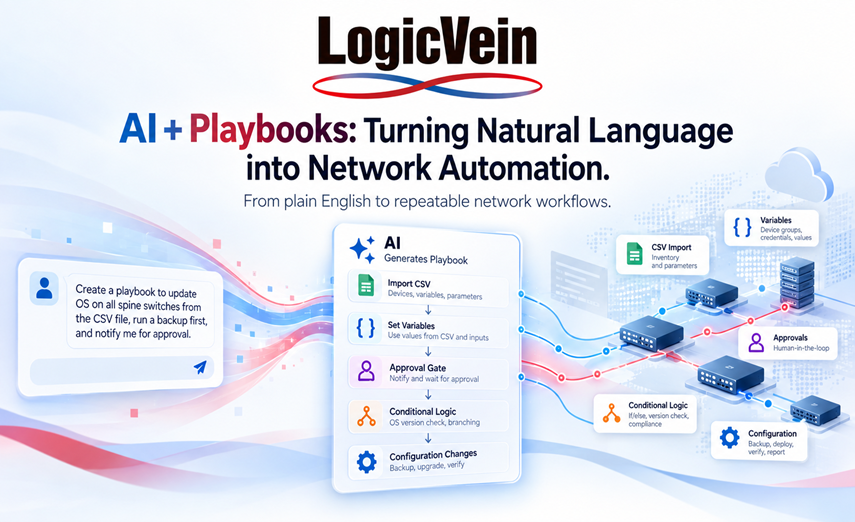
Instead of starting with individual automation nodes, variables, conditions, and configuration commands, an engineer could begin by simply describing the desired outcome in plain English. AI could then help translate that request into the structure of a LogicVein Playbook.
The engineer remains in control. AI simply helps bridge the gap between what the engineer wants to accomplish and how the automation should be constructed.
From Intent to Playbook
Imagine typing:
“Create a playbook json file following the playbook standards to change the login banner on all Cisco switches in the Northeast region. Read the site name and maintenance contact from a CSV file. Show me the devices that will be affected, require approval, make the change, and verify that the new banner is present.”
From that description, an AI-assisted workflow could recommend a playbook containing:
- A device selection step
- Variables for the banner text, site name, and contact information
- A CSV import containing device-specific values
- A validation step to confirm each device meets the required criteria
- An approval step before execution
- Conditional logic for different device types or operating systems
- Configuration commands
- A post-change validation step
- Success and failure handling
Instead of designing the entire workflow manually, the engineer starts with intent and receives a proposed automation structure.
The result is not “AI running the network.”
It is AI helping engineers build better automation faster.
Variables Make Natural Language Reusable
One of the most important parts of any automation workflow is separating the task from the values used by that task.
Consider a simple request:
“Create a playbook json file following the playbook standards to update the SNMP location on these devices.”
An AI assistant could recognize that the location should probably become a variable rather than being hard-coded into every command.
The resulting playbook might include variables such as:
DEVICE_NAME
SITE_NAME
SNMP_LOCATION
CONTACT_NAME
CHANGE_DATE
Those variables could then be referenced throughout the playbook.
A configuration template might look conceptually like:
snmp-server location
snmp-server contact
The same playbook could then be reused across hundreds or thousands of devices without rewriting the workflow.
AI can help identify which portions of a request should become variables, making playbooks more flexible from the beginning.
CSV Imports Bring Business Data into Automation
Natural-language automation becomes even more useful when combined with external data.
Suppose an engineer says:
“Update the branch router descriptions using the values in my deployment spreadsheet.”
LogicVein Playbooks can use CSV or spreadsheet data to drive automation.
For example:
| Device | Site | Circuit | Description |
|---|---|---|---|
| router-101 | Dallas | DIA-1001 | Dallas Headquarters |
| router-102 | Austin | MPLS-2022 | Austin Branch |
| router-103 | Houston | DIA-3044 | Houston Operations |
AI could help map those columns to playbook variables:
Device → DEVICE_NAME
Site → SITE_NAME
Circuit → CIRCUIT_ID
Description → INTERFACE_DESCRIPTION
The automation can then apply the correct information to each individual device.
This turns a spreadsheet containing operational data into a controlled network change process.
Conditional Logic Makes Automation Smarter
Real networks are rarely uniform.
A request such as:
“Disable the legacy SNMP community everywhere.”
may sound simple, but different devices may require different commands.
A Cisco IOS XE device might require one command while a Fortinet, Aruba, Juniper, or Palo Alto device requires another workflow entirely.
AI could help recognize those differences and recommend conditional logic such as:
IF vendor = Cisco
    Run Cisco configuration commands

ELSE IF vendor = Juniper
    Run Junos configuration commands

ELSE IF vendor = Fortinet
    Run FortiOS configuration commands
Conditions could also be based on:
- Operating system
- Software version
- Device model
- Site
- Device role
- Existing configuration
- Compliance status
- Interface state
- Previous command output
Instead of creating separate automation for every scenario, one playbook could intelligently adapt to the environment.
Approvals Keep Humans in Control
One of the biggest concerns surrounding AI-driven automation is control.
The solution does not have to be removing humans from the process.
In many environments, the better approach is making approval part of the automation.
An engineer might request:
“Generate the configuration changes, but do not deploy them until someone approves the job.”
AI could recognize the requirement and recommend a LogicVein Playbook containing a job approval step.
The workflow could become:
Identify devices
      ↓
Gather current configuration
      ↓
Generate proposed changes
      ↓
Validate changes
      ↓
Request approval
      ↓
Apply configuration
      ↓
Verify results
This provides the speed of automation while maintaining operational governance.
For high-impact network changes, that distinction matters.
AI can help build the process, but authorized engineers still decide whether the change proceeds.
Configuration Changes Become Easier to Describe
Network engineers usually think about the desired state rather than the individual automation steps required to reach it.
They might say:
“Set all access interfaces to 1 Gigabit unless they are already configured correctly.”
Or:
“Update the login banner with today's maintenance notice.”
Or:
“Shut down interfaces listed in this CSV file, but skip any interface currently carrying traffic.”
These requests naturally contain several automation concepts.
The last example contains:
- CSV input
- Variables
- Interface discovery
- Conditional logic
- Configuration changes
- Potential approval requirements
- Verification
AI could break the sentence into those components and recommend the corresponding LogicVein Playbook nodes.
That makes automation development much closer to the way engineers already describe operational tasks.
AI Could Also Recommend Existing Playbooks
AI does not always need to create something new.
In many organizations, the best answer may already exist.
An engineer might ask:
“I need to change interface speeds on 200 switches.”
Before creating another workflow, AI could search an organization's approved LogicVein Playbook library and respond:
“There is an existing Interface Configuration playbook that already performs this task. It supports interface selection, speed changes, approval, and post-change validation.”
This creates another valuable use for AI: playbook discovery.
As automation libraries grow, finding the right workflow can become almost as challenging as creating one.
Natural-language search could make an organization's automation library significantly easier to use.
AI as a Playbook Design Assistant
Another possibility is using AI as a design reviewer.
An engineer could build a playbook and ask:
“Review this workflow before I run it.”
AI could identify potential issues such as:
- No approval step before a high-impact change
- Missing rollback logic
- Variables that should not be hard-coded
- Commands that differ between operating systems
- Missing validation after the change
- Device groups that should be filtered
- A CSV column that is not mapped correctly
- A condition that could unintentionally include additional devices
In this model, AI becomes another set of eyes reviewing the automation process before anything reaches the network.
Explain the Playbook Before Running It
Automation becomes easier to trust when engineers can clearly understand what it will do.
Before execution, AI could summarize a proposed playbook in plain English:
This playbook will target 148 Cisco switches in the Northeast region. It will import site information from
branch-sites.csv, update the login banner, require approval before making changes, and verify the resulting configuration afterward. Devices that do not respond or do not match the supported software versions will be skipped and reported.
That type of explanation can make complex automation workflows easier to review—not only for the engineer who created them, but also for operations teams, change advisory boards, and management.
Natural Language Does Not Eliminate Engineering
There is an important distinction.
Natural-language automation should not mean:
“Tell AI something and blindly let it configure the network.”
A safer and more useful model is:
Describe → Build → Review → Approve → Execute → Verify
AI helps with the first several steps.
LogicVein Playbooks provide the controlled execution framework.
The network engineer remains responsible for the final decision.
That combination allows organizations to gain the productivity benefits of AI without abandoning the controls required for production network operations.
An Example
Consider this request:
“Upgrade the configuration on all branch switches listed in branches.csv. Only include Cisco devices running IOS XE 17.x. Set the new NTP servers, update the banner with today's date, and verify NTP afterward. Do not make any changes until I approve the job.”
An AI-assisted LogicVein workflow could interpret the request as:
Import branches.csv

        ↓

Select matching devices

        ↓

IF vendor = Cisco
AND OS = IOS XE
AND version begins with 17

        ↓

Set variables:
NTP_SERVER_1
NTP_SERVER_2
CHANGE_DATE

        ↓

Generate proposed configuration

        ↓

Request job approval

        ↓

Apply configuration

        ↓

Run validation commands

        ↓

IF validation succeeds
    Mark job successful
ELSE
    Raise exception / remediation action
A paragraph written by an engineer has now become the blueprint for a controlled automation workflow.
The Bigger Opportunity
The real opportunity created by AI is not simply generating configuration commands.
Network engineers can already do that.
The greater opportunity is converting operational intent into repeatable processes.
LogicVein Playbooks already provide the building blocks:
- Variables
- Approval workflows
- Conditional logic
- CSV and spreadsheet imports
- Configuration changes
- Validation
- Compliance checks
- Device interaction
- Repeatable execution
AI can make those capabilities easier to discover and assemble.
Instead of asking:
“Which nodes do I need to build this workflow?”
the engineer can start with:
“Here is what I want the network to do.”
That is a significant change in how network automation could be created.
From Commands to Intent
Network automation has traditionally required engineers to think like programmers.
AI creates the possibility of reversing that relationship.
The engineer describes the desired outcome.
AI helps translate that intent into automation.
LogicVein Playbooks provide the structured, controlled environment where the automation can be reviewed, approved, executed, and verified.
That means the future of network automation may not begin with a script or configuration command.
It may begin with a sentence.
Final Takeaway
With LogicVein, you don’t just react to changes — you control them.
Watch our series of videos here or see all our features here.
With its combination of discovery, monitoring, compliance, and automation, LogicVein transforms how IT teams manage complex network environments.
Whether you’re looking to reduce manual work, improve network reliability, or gain better visibility into device configurations, LogicVein will provide you with the tools you need—all in a single platform.
Ready to see LogicVein in action? Request a Demo and discover how you can simplify operations, improve reliability, and gain full network visibility.