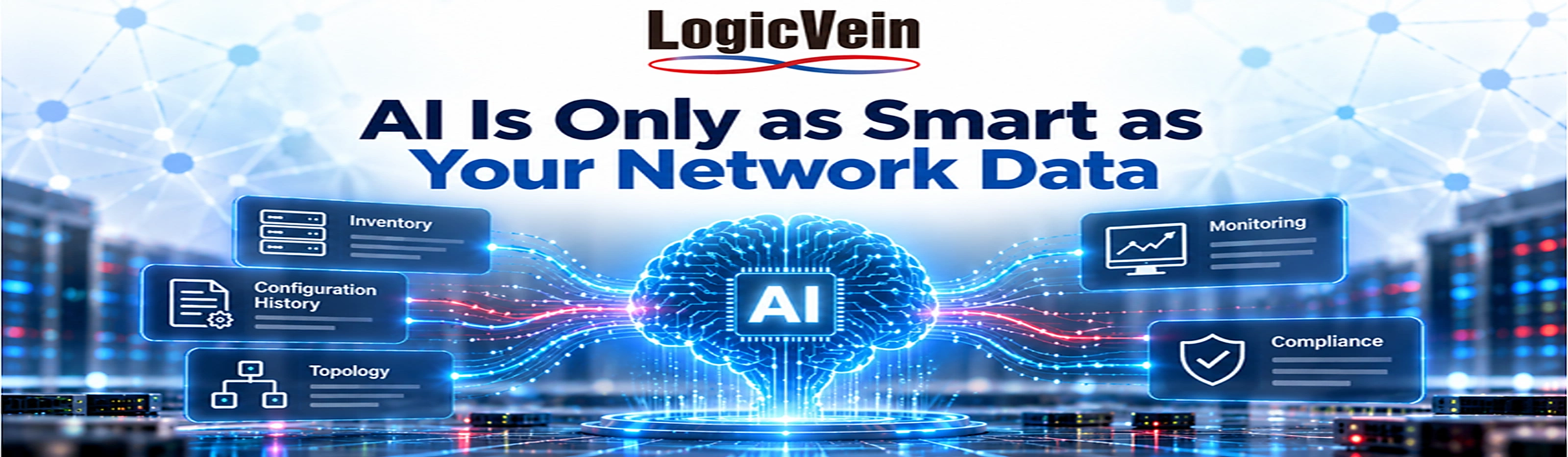

AI Is Only as Smart as Your Network Data
Why accurate inventory, configuration history, topology, monitoring, and compliance data are essential for meaningful AI-driven network operations.
AI Cannot Understand a Network It Cannot See
Artificial Intelligence is rapidly becoming part of the conversation around network operations. Organizations are exploring AI to accelerate troubleshooting, identify potential problems, analyze configurations, recommend changes, and reduce the manual work required to manage complex infrastructure.
The possibilities are exciting.
But there is a fundamental problem that often gets overlooked.
AI cannot make reliable decisions about a network it doesn't understand.
You can deploy the most advanced Large Language Model (LLM) available, but if it is working with outdated inventory, incomplete configuration history, inaccurate topology, or missing monitoring information, its recommendations may be incomplete—or simply wrong.
AI might understand how a Cisco router works, how OSPF operates, or what a firewall rule should look like.
What it doesn't automatically know is how your network is configured, what changed yesterday, which devices depend on one another, or whether your infrastructure meets your organization's operational standards.
That information must come from somewhere.
And that is where network management platforms like LogicVein become essential.
The Five Building Blocks of AI-Ready Network Data
Before AI can provide meaningful operational intelligence, organizations need a reliable foundation of network information.
1. Accurate Inventory: Knowing What You Have
Every useful AI analysis begins with knowing which devices exist and what they are.
An accurate inventory provides information such as:
- Device hostname, IP address, manufacturer, and model
- Operating system and firmware versions
- Hardware and interface information
- Device location, role, and organizational grouping
- Operational and management status
Consider asking an AI assistant:
Which network devices should we prioritize for a firmware upgrade?
Without accurate inventory, AI may recommend upgrades for devices that no longer exist, overlook unsupported hardware, or provide guidance for the wrong operating system.
With reliable inventory, it can evaluate the actual devices in the environment and help prioritize upgrade candidates based on relevant criteria.
LogicVein's Net LineDancer and ThirdEye provide centralized discovery and inventory capabilities that establish this foundation.
2. Configuration History: Understanding What Changed
Knowing how a device is configured today is valuable.
Knowing how that configuration has changed over time is even more powerful.
Imagine an application suddenly experiences connectivity problems. The monitoring system detects packet loss, but what caused it?
An AI assistant with access only to current configuration data may be able to identify suspicious settings.
An AI assistant with access to configuration history can investigate additional questions:
- Was there a configuration change shortly before the issue began?
- Which commands were added or removed?
- Did similar changes occur on other devices?
- Does the current configuration differ from the approved baseline?
- Is a previous known-good configuration available?
Net LineDancer automatically collects and stores device configurations, maintains revision history, and provides comparison capabilities.
This historical information gives AI something essential: evidence rather than assumptions.
Instead of simply suggesting possible causes, an AI-assisted workflow can identify changes that deserve investigation.
3. Network Topology: Understanding Relationships
A network is not simply a collection of independent devices.
Switches connect to routers. Firewalls protect network segments. Links provide redundant paths. Applications depend on infrastructure that may span multiple locations.
Understanding these relationships is essential when determining the potential impact of a problem.
Consider a switch experiencing unusually high interface errors.
Without topology information, AI sees an unhealthy interface.
With topology information, it may also determine that the interface connects to a distribution switch serving multiple downstream devices.
That additional context changes the urgency of the investigation.
Topology data can help AI-assisted workflows answer questions such as:
- Which devices might be affected by this outage?
- Are neighboring devices experiencing similar issues?
- Is this link part of a redundant path?
- Which network segments depend on this infrastructure?
- Where should troubleshooting begin?
ThirdEye's network mapping and topology capabilities help provide the relationships needed to put operational events into context.
AI becomes more useful when it understands not just individual devices, but how those devices work together.
4. Monitoring Data: Understanding What Is Happening
Configurations describe how a network is supposed to operate.
Monitoring shows how it is actually behaving.
That distinction matters.
A perfectly configured interface can still experience packet loss, congestion, hardware errors, or intermittent connectivity.
To make useful recommendations, AI needs operational information such as:
- Device and interface availability
- Bandwidth utilization and performance trends
- CPU and memory consumption
- SNMP traps and syslog events
- Threshold violations and incident history
- Historical performance measurements
ThirdEye provides network monitoring, alerting, performance collection, and operational dashboards.
When this information is combined with configuration history, an AI-assisted system can examine both the symptoms of a problem and changes that may have contributed to it.
For example, it could investigate whether increased packet loss began after a configuration update or whether an interface has been experiencing gradually increasing errors.
The objective is not simply to generate more alerts.
It is to help engineers understand which alerts matter and why.
5. Compliance Data: Understanding What Is Acceptable
AI should not assume that every technically valid configuration is appropriate for an organization's network.
Organizations have operational standards, security requirements, and approved configuration practices.
A configuration might function correctly while still violating company policy.
For example:
- An unauthorized management protocol is enabled.
- Required logging statements are missing.
- SNMP settings do not match security standards.
- An interface lacks required configuration parameters.
- A device has drifted from its approved baseline.
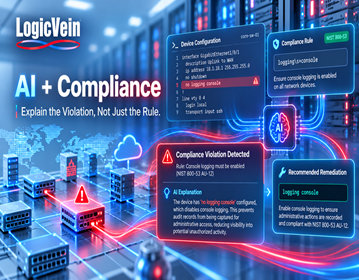
Net LineDancer's compliance capabilities allow organizations to define configuration policies and evaluate devices against those requirements.
This provides AI with another important layer of context.
Instead of simply asking, "Does this configuration work?"
AI can help investigate, "Does this configuration meet our standards, and what should we do about any violations?"
The distinction is critical when AI is being used to recommend configuration changes.
Reporting: Turning Network Information into Usable Intelligence
Collecting accurate data is the beginning. Making that information accessible, consistent, and understandable is the next challenge.
This is where reporting and analytics become especially valuable.
LogicVein's reporting capabilities help transform network inventory, configuration activity, compliance results, and monitoring information into operational insights.
For example, a reporting environment might expose:
- Percentage of devices with successful configuration backups
- Devices with recent configuration changes
- Compliance violations by device, site, or severity
- Network availability and performance trends
- Devices requiring operational attention
- Historical patterns across infrastructure groups
These datasets provide a structured foundation for analytics and AI-assisted investigation.
Rather than expecting an LLM to interpret thousands of raw configuration files or unrelated monitoring events, organizations can supply relevant operational information in a consistent format.
NCCM provides the configuration history. NMS provides operational visibility. Reporting makes the information easier to analyze and act upon.
Together, they create the trusted operational context that useful AI depends on.
What Happens When AI Has the Right Data?
Consider a hypothetical situation.
A network engineer asks an AI assistant:
"Why did connectivity to our Dallas office become unstable this morning?"
A generic LLM might respond with standard troubleshooting suggestions:
Check the interfaces. Review routing. Look for congestion. Examine recent changes.
Those suggestions are reasonable, but they are not specific to the actual problem.
Now imagine the assistant has authorized access to relevant LogicVein information.
It retrieves the following:
Inventory: The Dallas location contains two distribution switches and an edge router.
Monitoring: Interface errors began increasing on an uplink at approximately 9:15 AM.
Configuration History: A configuration change occurred on the connected switch at 9:08 AM.
Topology: The affected uplink connects the distribution layer to the edge router.
Compliance: A configuration policy violation was detected on the interface following the change.
With this information, the AI assistant could produce a much more useful response:
"Monitoring shows increased errors on the distribution uplink beginning at 9:15 AM. A configuration change occurred on the connected switch seven minutes earlier, and the current configuration does not meet the defined interface policy. These findings suggest that the recent change should be investigated first."
That is a fundamentally different level of assistance.
The AI is no longer offering generic troubleshooting advice.
It is interpreting actual operational evidence, identifying a possible relationship, and recommending a focused investigation.
The evidence does not automatically prove the root cause, but it gives the engineer a much better starting point.
Connecting LogicVein to AI Through APIs and MCP
The next logical question is:
How do we actually make this network information available to AI?
One practical approach is to connect LogicVein's operational data to an AI environment through its APIs and an integration layer such as the Model Context Protocol (MCP).
MCP provides a standardized way for AI applications to access external tools and information.
In this architecture, an organization could:
- Use LogicVein to collect inventory, configuration history, monitoring, topology, and compliance information.
- Expose selected information through LogicVein APIs and reporting services.
- Build or configure an MCP integration that allows an authorized LLM to request relevant network information.
- Allow the LLM to analyze that information and generate explanations, summaries, or recommended actions.
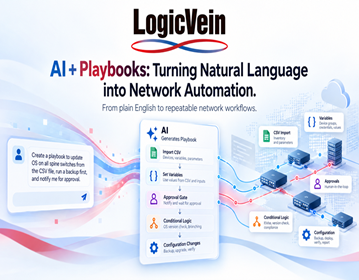
- Use established LogicVein automation capabilities, such as Playbooks, to execute approved and validated operational changes.
This is an integration approach organizations can develop—not a claim that every capability is automatically available through a built-in AI assistant.
Importantly, the AI does not need unrestricted access to network devices.
An initial implementation could provide read-only access to relevant operational data, with timestamps, source references, and appropriate permissions.
When action is required, human approvals, change controls, logging, and established automation workflows can remain in place.
AI can help determine what should be investigated or changed. LogicVein provides the operational information and controlled automation needed to support that process.
Start with the Data, Not the AI Model
Organizations often begin their AI discussions by evaluating models, platforms, and automation frameworks.
Those decisions matter, but they should not be the first step.
Before investing heavily in AI-driven network operations, ask:
- Is our device inventory complete and current?
- Are we consistently backing up configurations?
- Can we identify when configurations changed?
- Do we understand the relationships between network devices?
- Are we collecting meaningful monitoring and performance data?
- Have we defined and implemented configuration compliance policies?
- Can we access this information through reporting and APIs?
- Can we verify the freshness, accuracy, and source of information provided to AI?
If the answers are uncertain, that is where the work should begin.
AI cannot compensate for network information that was never collected, is no longer accurate, or cannot be reliably associated with the correct devices.
The LogicVein Advantage: Building the Foundation for Intelligent Operations
LogicVein brings together the capabilities that organizations need to establish reliable network operational data.
Net LineDancer (NCCM) provides configuration backup, change tracking, inventory, compliance, and automation.
ThirdEye (NMS) provides network monitoring, alerting, performance information, and topology visibility.
ThirdEye Suite brings these capabilities together into a unified network operations platform.
Reporting and APIs help make operational information accessible for analysis, integrations, and future AI-driven workflows.
The result is more than a collection of network management features.
It is a foundation of operational knowledge that organizations can use to support intelligent analysis and better decision-making.
AI technology will continue to evolve. Models will become faster, more capable, and better integrated into enterprise operations.
But one principle will remain constant:
AI is only as smart as the network data you give it.
The organizations that gain the greatest value from AI will not necessarily be those that adopt the newest model first.
They will be those that already understand their networks—and have the reliable data to prove it.
Final Takeaway
With LogicVein, you don’t just react to changes — you control them.
Watch our series of videos here or see all our features here.
With its combination of discovery, monitoring, compliance, and automation, LogicVein transforms how IT teams manage complex network environments.
Whether you’re looking to reduce manual work, improve network reliability, or gain better visibility into device configurations, LogicVein will provide you with the tools you need—all in a single platform.
Ready to see LogicVein in action? Request a Demo and discover how you can simplify operations, improve reliability, and gain full network visibility.