
AI + Draft Config: Build Better Network Changes Faster
How AI-assisted configuration development and LogicVein's Draft Configurations can help network teams make changes faster without sacrificing control.
Network Changes Are Getting More Complex
Network engineers spend considerable time creating, modifying, reviewing, and deploying device configurations. Whether updating access control lists, modifying routing protocols, implementing security policies, or standardizing device settings, even relatively small changes require careful planning.
The challenge becomes greater in multi-vendor environments, where configuration syntax, operating systems, and device capabilities can vary significantly.
Artificial intelligence (AI) offers an opportunity to accelerate this work.
But there is an important distinction between AI generating a configuration and an organization safely deploying that configuration into production.
That is where LogicVein's Net LineDancer (netLD) Draft Configurations can play an important role.
AI can help engineers develop proposed changes. LogicVein provides the configuration management capabilities needed to review those changes, compare them against existing configurations, and control their deployment.
AI as a Configuration Assistant
Imagine a network engineer preparing changes for several switches.
Instead of manually constructing every command, the engineer could ask an AI assistant:
Create a proposed configuration for a Cisco Catalyst switch that updates the NTP servers, adds the required SNMP settings, and preserves existing interface and security configurations.
With sufficient device and network context, AI could help:
- Generate candidate configuration commands.
- Explain the purpose of individual changes.
- Identify potential configuration inconsistencies.
- Adapt commands for different network operating systems.
- Suggest validation steps and potential rollback considerations.
- Produce configuration text for engineering review.
This can reduce the time spent preparing repetitive configuration changes.
However, AI-generated configurations should never be considered automatically correct. AI may produce unsupported commands, overlook existing dependencies, or misunderstand the network's operational requirements.
AI should assist the engineer, not replace engineering judgment.
From AI-Generated Configuration to LogicVein Draft Config
Once an engineer has a proposed configuration, the next challenge is determining how to review and deploy it safely.
Net LineDancer includes a feature called Draft Configurations, designed for preparing and managing device configuration changes.
Draft Configurations allows engineers to create a working configuration from an existing device configuration or import configuration text from an external file.
This creates a practical opportunity for AI-assisted configuration development.
An engineer can use an AI tool to prepare proposed configuration text, then import that text into netLD as a draft.
Within netLD, the engineer can edit the draft and compare it against the device's existing configuration.
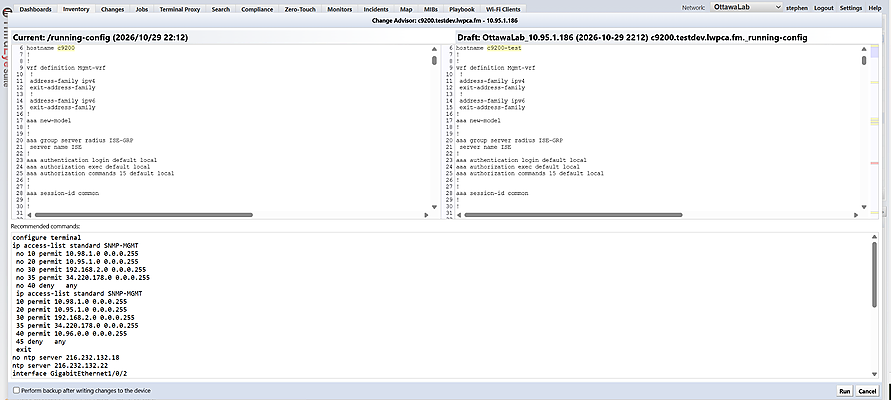
Figure 1: LogicVein Net LineDancer – Draft Configuration and Change Advisor. The current configuration appears alongside the proposed draft, while Change Advisor presents recommended commands for implementing the differences.
In this example, Net LineDancer compares the current Cisco switch configuration with a proposed draft. Change Advisor generates recommended commands that address differences involving access control lists, NTP settings, and other configuration parameters.
The engineer can inspect the proposed changes and the generated commands before choosing whether to execute them. This illustrates how AI-assisted configuration preparation can complement LogicVein's existing review and change-management capabilities without giving an AI system unrestricted access to production devices.
A More Controlled Configuration Workflow
Combining AI-assisted drafting with LogicVein's configuration management features creates a practical workflow:
- Define the change. The engineer describes the required network modification, target devices, and expected behavior.
- Generate a candidate configuration. An approved AI tool assists with creating the proposed commands or configuration file.
- Import into Draft Configurations. The engineer imports the configuration into netLD or creates a draft based on the existing device configuration.
- Review and validate. The proposed configuration is compared with the current device configuration. Engineers examine the differences, verify command compatibility, and perform appropriate testing.
- Obtain approval. The change follows the organization's established change-control process. Where applicable, LogicVein's job approval capabilities and access controls can support authorized execution.
- Deploy and verify. After authorization, the reviewed change can be applied through the appropriate netLD workflow. Engineers then verify device behavior and confirm the intended configuration state.
The process separates configuration creation from deployment authorization. That separation is essential when introducing AI into network operations.
Why Configuration Comparisons Matter
One of the greatest risks associated with AI-generated network configurations is that a proposed change may contain more modifications than originally requested.
For example, an engineer might request a routing adjustment, but an AI-generated configuration could inadvertently alter interface parameters or remove an existing setting.
Without a comparison process, these changes may be difficult to identify.
LogicVein's Draft Configurations allows engineers to compare proposed configurations with existing configurations before deployment. This provides several advantages:
- Change visibility: Understand which configuration sections are being modified.
- Risk reduction: Identify unexpected changes before applying them.
- Operational consistency: Compare proposed settings against established configurations.
- Accountability: Keep configuration changes within a managed operational environment.
Configuration comparisons do not replace testing or guarantee that a change will work as intended. They provide an opportunity to catch unintended modifications before those modifications affect production devices.
Approvals and Human Oversight Remain Essential
AI can generate configuration recommendations quickly, but it does not understand every organization's operational policies, maintenance requirements, or business risks.
A configuration that is technically valid may still be inappropriate for a particular environment.
Consider an AI recommendation to modify a firewall access rule. The proposed configuration might be syntactically correct but could unintentionally expose an internal service.
An engineer still needs to determine whether the change complies with security policies and whether the business impact is acceptable.
This is why approval processes remain important.
LogicVein provides user permissions and job approval capabilities that can be incorporated into appropriate network operations workflows. Organizations can combine those capabilities with their established review and change-management procedures.
The goal is not to eliminate human involvement. It is to allow AI to reduce preparation time while authorized personnel retain responsibility for validating and executing changes.
Beyond Draft Config: Building a Complete Change Process
Draft Configurations is only one component of LogicVein's broader network configuration and change management capabilities.
For organizations looking to expand their automation efforts, netLD also provides additional tools:
Configuration Backup and History Maintain historical device configurations and establish reference points for comparison and recovery.
Change Advisor Analyze configuration differences and generate commands associated with implementing changes.
Smart Change Standardize repetitive configuration changes across multiple devices using reusable templates and device-specific parameters.
Playbooks Build repeatable automation workflows that combine multiple operational steps, checks, and actions.
Together, these capabilities provide a foundation for incorporating AI-generated recommendations into more structured network operations.
AI can assist with determining what should change, while LogicVein supports the operational processes used to manage those changes.
Protecting Sensitive Network Information
Organizations should also consider how AI tools receive configuration information.
Network configurations can contain sensitive details such as internal addresses, authentication settings, network topology information, and security policies.
Before providing configuration data to an AI service, organizations should ensure that the service is approved for the information being shared. Sensitive credentials and unnecessary operational data should be removed or protected.
An effective AI-assisted workflow should improve operational efficiency without compromising network security or organizational data-handling requirements.
The Future Is AI-Assisted, Engineer-Controlled Networking
AI is changing how network engineers approach configuration development.
Tasks that once required manually researching commands, constructing configuration templates, and reviewing numerous examples can increasingly begin with an AI-generated candidate.
But generating a configuration is only the beginning.
Successful network changes still require understanding the existing environment, validating the proposed modifications, obtaining authorization, and confirming the results.
LogicVein's Draft Configurations provides a practical connection between AI-assisted configuration preparation and controlled network change management.
Rather than allowing AI to make unrestricted modifications to production infrastructure, engineers can use AI to accelerate preparation while retaining control of the deployment process.
AI helps create the change. LogicVein helps you control it.
That combination offers a practical path toward faster, more consistent, and more accountable network operations.
Explore LogicVein Draft Configurations
Learn how Net LineDancer helps your team prepare, compare, and deploy network configurations while maintaining visibility and operational control.
Explore LogicVein Net LineDancer to learn more about Draft Configurations, Change Advisor, Smart Change, and Playbooks.
Final Takeaway
With LogicVein, you don’t just react to changes — you control them.
Watch our series of videos here or see all our features here.
With its combination of discovery, monitoring, compliance, and automation, LogicVein transforms how IT teams manage complex network environments.
Whether you’re looking to reduce manual work, improve network reliability, or gain better visibility into device configurations, LogicVein will provide you with the tools you need—all in a single platform.
Ready to see LogicVein in action? Request a Demo and discover how you can simplify operations, improve reliability, and gain full network visibility.