
AI + Compliance: Explain the Violation, Not Just the Rule
Turning network compliance findings into actionable insights with AI and LogicVein
Network compliance is essential for maintaining security, operational consistency, and regulatory alignment. Organizations rely on configuration policies to ensure that network devices follow established standards, security requirements, and operational best practices.
But identifying a compliance violation is only the beginning.
Knowing that a device failed a compliance check is useful. Understanding what failed, why it matters, and how to correct it is far more valuable.
This is where artificial intelligence could transform traditional network compliance management.
By combining LogicVein's existing compliance capabilities with AI-assisted configuration analysis, organizations could move beyond simply identifying violations toward understanding and resolving them.
The Challenge with Traditional Compliance Reporting
Most network compliance tools are designed to answer a straightforward question:
Does this device configuration meet the organization's defined standards?
For example, a compliance policy might verify that:
- SSH is enabled and insecure management protocols are disabled.
- Approved SNMP community strings are configured.
- Required logging destinations are present.
- NTP servers match organizational standards.
- Password and authentication policies are enforced.
- Specific routing or interface configuration requirements are satisfied.
When a device fails one of these checks, the compliance engine identifies the violation.
However, administrators may still need to investigate several questions:
- Which configuration setting caused the failure?
- What is the potential security or operational impact?
- Is the violation critical or simply a configuration inconsistency?
- What configuration changes are necessary?
- Could correcting the issue affect other services?
For experienced network engineers, answering these questions may be relatively straightforward. For less experienced administrators or teams managing multiple network vendors, the investigation can become time-consuming.
A compliance violation should be the beginning of an explanation, not the end of the analysis.
Building on LogicVein's Compliance Capabilities
LogicVein's Net LineDancer and ThirdEye Suite provide configuration management and compliance capabilities that help organizations evaluate network devices against established policies.
Using regular expressions (regex), administrators can define rules that identify required, prohibited, or potentially problematic configuration statements.
For example, a compliance policy might look for an insecure SNMP community string:
snmp-server community public RO
A regex-based compliance rule could identify the use of the default public community string and generate a violation.
This provides an important foundation for automated compliance monitoring.
But imagine taking the process one step further.
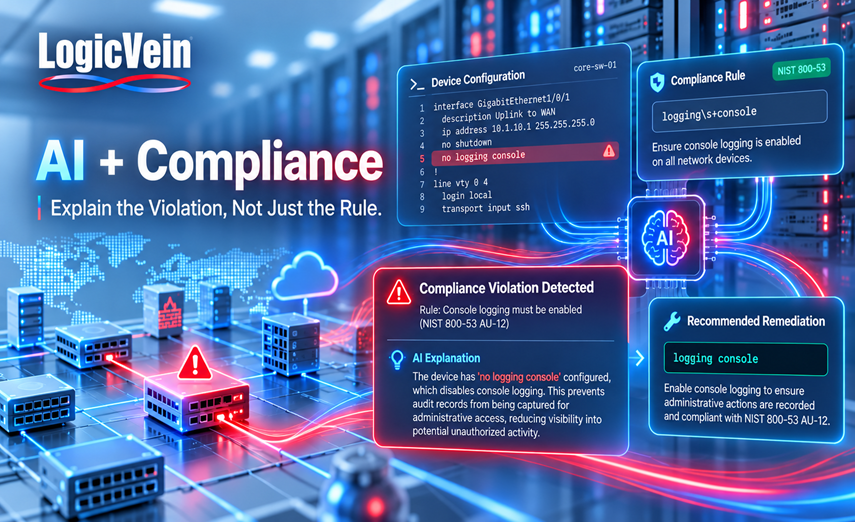
Instead of presenting only the failed rule, AI could analyze the violation alongside the relevant device configuration and provide an understandable explanation.
From Compliance Violation to AI-Powered Explanation
Consider a Cisco switch that fails an SNMP security policy.
Traditional Compliance Result
Device: CORE-SW-01
Policy: SNMP Security Standards
Result: FAILED
Violation: Unauthorized SNMP Community String
The compliance system correctly identifies a problem, but the network administrator must determine what the violation means and how it should be addressed.
Potential AI-Enhanced Compliance Result
Device: CORE-SW-01
Policy: SNMP Security Standards
Status: Compliance Violation
What Failed?
The device configuration contains the following statement:
snmp-server community public RO
The configured SNMP community string does not meet the organization's approved security policy.
Why Does It Matter?
The community string public is widely known and commonly used as a default value.
Although the configuration provides read-only access, an unauthorized individual with network access to the SNMP service could potentially retrieve information about the device, including interface details and other operational data.
This information could assist an attacker in understanding the network environment.
Suggested Remediation
Remove the unauthorized community string and configure an approved monitoring method.
For example:
no snmp-server community public RO
Where supported, consider using SNMPv3 with authentication and encryption rather than SNMPv2c community strings.
Operational Considerations
Before making the change, verify that existing monitoring systems do not depend on the community string. Removing it without updating the monitoring platform could interrupt SNMP polling and network visibility.
Recommended Action
Review the device's SNMP configuration, validate monitoring dependencies, and submit the proposed change through the organization's established change management process.
The difference is significant.
The original compliance result reports a failure. The AI-enhanced explanation provides context, identifies potential consequences, and suggests a path toward remediation.
The administrator remains responsible for reviewing and approving any configuration changes.
How AI Could Work with LogicVein Compliance
A future AI-assisted compliance workflow could combine three important sources of information.
1. Regex-Based Compliance Policies
LogicVein's compliance engine evaluates device configurations against administrator-defined rules.
These rules determine whether configuration requirements have been satisfied or violated.
The compliance engine remains the authoritative source for the policy result. AI does not need to replace the existing regex evaluation.
Instead, it can interpret the findings generated by the compliance engine.
2. Configuration Analysis
LogicVein maintains device configurations through its network configuration management capabilities.
AI could examine relevant configuration sections to better understand the circumstances surrounding a violation.
For example, if a compliance policy reports that centralized logging is not configured, AI could evaluate the configuration and explain:
- Which logging statements are missing or incorrect.
- Why centralized logging supports security monitoring and troubleshooting.
- Which vendor-specific commands may be relevant.
- What operational dependencies should be checked before remediation.
This context is particularly valuable in multivendor environments where Cisco, Juniper, Fortinet, Palo Alto, Aruba, and other platforms use different configuration syntax.
3. AI-Generated Explanations and Remediation Guidance
With the policy violation and relevant configuration information available, AI could produce an explanation tailored to the affected device.
A potential response could include:
Violation Summary: A plain-language description of the failed policy.
Risk Explanation: The potential security or operational consequences.
Configuration Evidence: The relevant configuration statements supporting the finding.
Suggested Remediation: Vendor-specific commands or configuration recommendations.
Change Considerations: Dependencies, potential service impact, and validation steps.
Verification: Guidance for confirming that the device passes the compliance check after remediation.
Importantly, generated recommendations should be validated against the device model, operating system version, and organizational standards before implementation.
The Value of AI in Multivendor Networks
One of the challenges of network compliance is that different vendors often implement similar security and operational requirements using different commands.
For example, configuring secure management access on a Cisco device is different from performing the equivalent task on a Juniper or Fortinet device.
The organization's compliance objective may be the same, but the configuration syntax and remediation procedures can vary significantly.
AI could help bridge this gap.
Rather than requiring administrators to manually research each platform, AI-assisted compliance could provide vendor-aware explanations and suggested configuration changes.
This could be particularly useful for network teams responsible for hundreds or thousands of devices across multiple platforms.
The goal would not be to eliminate the need for vendor expertise. Instead, it would be to make that expertise more accessible and reduce repetitive investigation.
Connecting Compliance with LogicVein Playbooks
Identifying and explaining a violation is valuable.
Connecting that explanation with controlled network automation could be even more powerful.
LogicVein Playbooks already provide capabilities for automating network operations, including configuration changes, conditional logic, variables, and approval workflows.
A potential AI-assisted compliance process could connect these capabilities.
Step 1: Detect the Violation
LogicVein evaluates the device configuration against the organization's compliance policies.
Step 2: Explain the Finding
AI analyzes the reported violation and relevant configuration evidence, producing a plain-language explanation and recommended corrective action.
Step 3: Recommend a Playbook
Based on the violation type and device platform, AI could recommend an existing LogicVein Playbook or help an administrator develop a new remediation workflow.
Step 4: Review and Approve
The administrator reviews the proposed changes, evaluates potential service impact, and approves the remediation through the appropriate change management process.
Step 5: Execute and Verify
Once approved, a LogicVein Playbook could implement the required configuration changes.
A subsequent compliance evaluation could verify that the device now satisfies the policy.
This creates an opportunity to move from isolated compliance alerts toward a structured process for detection, explanation, approval, remediation, and verification.
A Practical Example: Missing NTP Configuration
Consider another common compliance issue: a router does not have the organization's approved NTP servers configured.
A traditional compliance check might report:
Policy: Approved NTP Servers
Status: FAILED
An AI-enhanced explanation could provide additional context.
What Failed?
The router does not contain the required NTP server configuration statements.
Why Does It Matter?
Accurate time synchronization is important for event correlation, security investigations, troubleshooting, and consistent logging across network devices.
Devices operating with incorrect timestamps can make identifying the sequence of events during an outage or security incident more difficult.
Suggested Remediation
For a compatible Cisco IOS device, the recommended configuration might resemble:
ntp server 10.10.10.10 prefer
ntp server 10.10.10.11
These addresses are illustrative; actual values would come from the organization's approved NTP configuration.
Verification
After implementing the change, an administrator could validate time synchronization using appropriate operational commands, such as:
show ntp associations
show ntp status
The compliance policy could then be evaluated again to confirm that the expected NTP statements are present.
This example demonstrates how AI could translate a relatively simple compliance result into useful operational guidance.
Keeping Humans in Control
AI-assisted compliance should strengthen existing operational controls, not bypass them.
Generating a remediation recommendation is fundamentally different from automatically applying that recommendation to a production device.
Before changes are executed, organizations should consider:
- Whether the recommendation aligns with approved security policies.
- Whether the proposed commands are valid for the device platform and software version.
- Whether the change might interrupt management connectivity, monitoring, or production traffic.
- Whether required change approvals have been obtained.
- Whether a configuration backup and rollback procedure are available.
LogicVein's configuration management, backup, and Playbook approval capabilities provide a foundation for incorporating these safeguards into a controlled workflow.
AI should serve as an intelligent assistant to network administrators, while established compliance rules and organizational change controls remain authoritative.
From Reactive Compliance to More Proactive Operations
The longer-term opportunity extends beyond explaining individual violations.
As organizations accumulate compliance findings, configuration histories, and remediation outcomes, AI could potentially help identify broader operational patterns.
For example, AI-assisted analysis could highlight:
- Devices repeatedly failing the same compliance policy.
- Configuration differences across similar network devices.
- Common violations introduced during provisioning or upgrades.
- Compliance trends associated with particular vendors or software versions.
- Opportunities to standardize recurring remediation activities through Playbooks.
These insights could help organizations address systematic configuration problems rather than repeatedly correcting individual devices.
Over time, compliance could become a more proactive part of network operations.
Where MCP Fits
MCP is an open protocol that allows an AI application to discover and call tools exposed by an MCP server. The LLM remains in the user's chosen MCP-capable application; the MCP server provides a controlled interface to relevant data and operations.
For a LogicVein compliance use case, the architecture could look like this:
LogicVein compliance results + saved configurations
                    |
       Approved API / export / integration
                    |
          Read-only MCP server
                    |
        MCP-capable AI application
                    |
            Your favorite LLM
                    |
    Explanation + proposed remediation
                    |
         Engineer review and approval
                    |
      Approved LogicVein Playbook
                    |
       Backup, validate, recheck
This is an integration pattern, not a claim that every LogicVein installation currently ships with a native compliance MCP server. Where an approved API is available, the MCP server could use it. For a lab or proof of concept, a sanitized export can be enough to get started.
What About Different LLMs?
This is one of MCP's strengths. Instead of writing a separate integration for every AI model, an organization can build a reusable MCP server and connect it to compatible AI applications.
Whether a team prefers an OpenAI model, Claude, or a locally hosted model, the general pattern remains the same: the MCP-capable host connects to the tools, the tools return approved LogicVein evidence, and the model helps interpret that evidence. Actual MCP support depends on the client application, not just the model name.
For environments with strict data-handling requirements, the architecture should also account for where configuration excerpts are processed and stored.
The Future of Compliance Is Understanding
Traditional compliance systems are highly effective at identifying whether configurations meet defined requirements.
But network administrators need more than a pass-or-fail result.
They need to understand the issue, evaluate the consequences, and determine the safest way to correct it.
By combining LogicVein's regex-based compliance policies, configuration management capabilities, and Playbook automation with AI-assisted analysis, organizations could make compliance findings more informative and actionable.
The opportunity is not to replace deterministic compliance checks with AI-generated judgments. It is to enhance reliable policy evaluation with meaningful explanations, contextual recommendations, and controlled remediation workflows.
The next evolution of network compliance isn't simply identifying what failed. It's helping network teams understand why it failed, why it matters, and what to do next.
LogicVein provides network configuration management, compliance monitoring, and automation capabilities through Net LineDancer and ThirdEye Suite. The AI-assisted explanations, remediation recommendations, and integrated workflows discussed in this article represent potential future capabilities and conceptual use cases, rather than an announcement of currently available functionality.
Final Takeaway
With LogicVein, you don’t just react to changes — you control them.
Watch our series of videos here or see all our features here.
With its combination of discovery, monitoring, compliance, and automation, LogicVein transforms how IT teams manage complex network environments.
Whether you’re looking to reduce manual work, improve network reliability, or gain better visibility into device configurations, LogicVein will provide you with the tools you need—all in a single platform.
Ready to see LogicVein in action? Request a Demo and discover how you can simplify operations, improve reliability, and gain full network visibility.