
Why High Availability Matters for Network Management Platforms
When organizations think about high availability, they usually focus on routers, switches, firewalls, servers, and applications. But one system is often overlooked:
The platform managing all of them.
Your network management platform is where engineers monitor outages, track alerts, automate fixes, back up configurations, audit changes, and recover from incidents. If that system goes offline during a critical event, the operational impact can be severe.
High availability is not just a feature. It is a requirement.
The Hidden Risk of a Single Management Server
Many organizations still run monitoring and configuration tools on a single virtual machine or standalone server. It works—until it doesn’t.
When that server fails, teams may lose access to:
-
Device monitoring dashboards
-
Alert visibility
-
Configuration backups
-
Compliance reporting
-
Automated remediation jobs
-
Change history and rollback tools
-
SSH jump access to devices
-
Scheduled tasks and scripts
During an outage, losing your management platform creates a second outage.
What High Availability Should Actually Mean
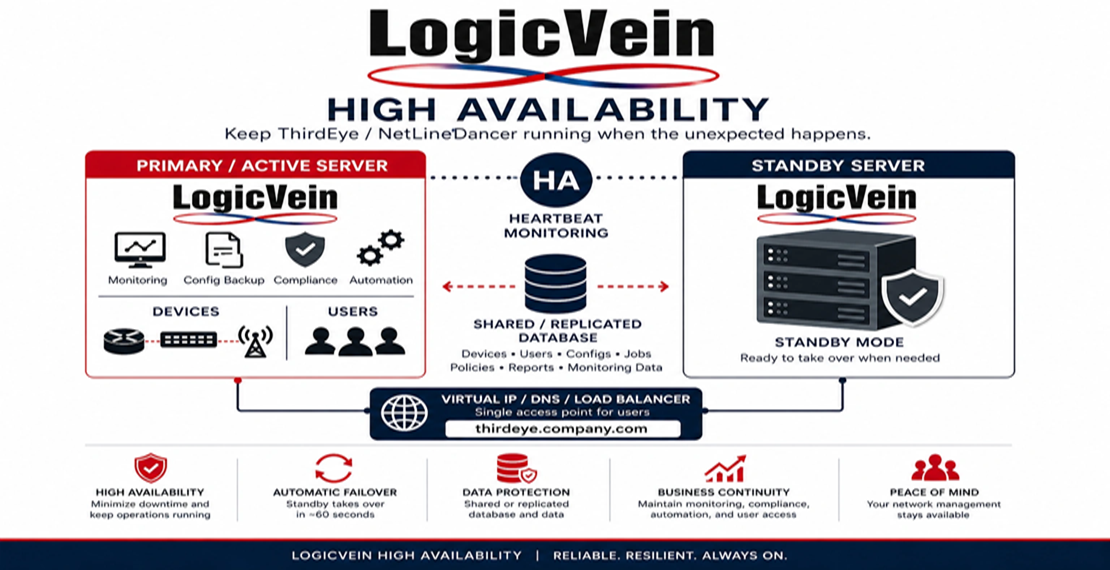
Some vendors market “backup servers” or “cold standby” systems as HA. That is not enough.
Real high availability should provide:
Automatic Failover
If the primary node becomes unavailable, a standby node should take over quickly with minimal interruption.
Synchronized Data
User accounts, device inventories, alerts, policies, historical data, jobs, and configuration archives should remain current across systems.
Operational Continuity
Admins should continue logging in, running jobs, accessing dashboards, and restoring configurations without rebuilding the environment.
Simple Recovery
Once the failed node is repaired, it should rejoin cleanly without risky manual migrations.
Why It Matters in the Real World
Imagine these scenarios:
Major Core Failure at 2:00 AM
Your NOC needs alert visibility immediately. If the monitoring platform is down too, response time doubles.
Ransomware or VM Corruption
The management server becomes unavailable. Without HA, years of archives, credentials, and automation workflows may be inaccessible.
Planned Maintenance
Infrastructure teams need to patch hypervisors or hosts. HA allows maintenance without taking down operations tooling.
Compliance Audit
Auditors request historical change records and backup evidence. If your platform is offline, proving control becomes difficult.
Why Network Management HA Is Different
Unlike a typical application, network operations platforms often hold the keys to recovery:
-
Stored credentials
-
Device access workflows
-
Golden configurations
-
Backup archives
-
Automation playbooks
-
Topology intelligence
-
Incident timelines
If those tools disappear during a crisis, engineers lose both visibility and leverage.
What to Ask Vendors
When evaluating any network management platform, ask:
-
Is failover automatic or manual?
-
How long does recovery take?
-
What data is replicated in real time?
-
Are users and jobs preserved?
-
Can both monitoring and configuration functions fail over?
-
How is licensing handled after failover?
-
How often is HA tested by customers?
-
These answers separate checkbox HA from production-ready HA.
How LogicVein Approaches Resilience
LogicVein platforms are built for organizations that depend on constant operational visibility and control. High availability designs help ensure that monitoring, configuration management, user access, and operational workflows remain available when infrastructure problems occur.
That means fewer blind spots, faster recovery, and less stress when incidents happen.
Final Thought
If your network management system is mission critical every normal day, it becomes even more critical on your worst day.
High availability is not about hardware redundancy. It is about protecting the team responsible for restoring service.
When failure hits, the last system you want offline is the one designed to help you recover.nly reduce risk and cost—they unlock the ability to scale, innovate, and operate with confidence.
Final Takeaway
With LogicVein, you don’t just react to changes — you control them.
Watch our series of videos here or see all our features here.
With its combination of discovery, monitoring, compliance, and automation, LogicVein transforms how IT teams manage complex network environments.
Whether you’re looking to reduce manual work, improve network reliability, or gain better visibility into device configurations, LogicVein will provide you the tools you need—all in a single platform.
Ready to see LogicVein in action? Request a Demo and discover how you can simplify operations, improve reliability, and gain full network visibility.