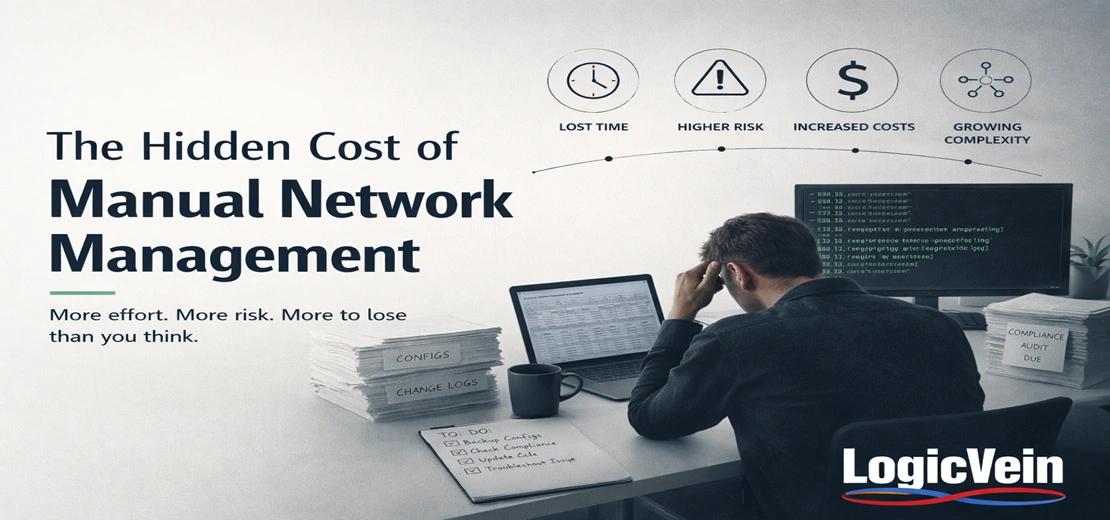

The Hidden Cost of Manual Network Management
In many organizations, manual network management is still the default approach. Engineers log into devices one by one, run commands through CLI sessions, update spreadsheets, and rely on institutional knowledge to keep everything running. It works—until it doesn’t. What appears to be a cost-effective method often hides significant inefficiencies that quietly impact performance, security, and scalability. As networks grow more complex, the true cost of manual management becomes impossible to ignore.
1. Time Drain and Operational Inefficiency
Manual processes consume valuable engineering time. Routine tasks like configuration backups, firmware updates, VLAN changes, or compliance checks must be repeated across dozens—or thousands—of devices. Instead of focusing on strategic initiatives, engineers are stuck performing repetitive work:
- Logging into devices individually
- Copying and pasting configurations
- Running the same commands across environments
- Documenting changes manually
These tasks don’t scale. What takes minutes on a small network can take days in a large environment.
2. Increased Risk of Human Error
Even the most experienced engineers make mistakes—especially when performing repetitive tasks under pressure. A missed command, a typo, or applying the wrong configuration to the wrong device can lead to outages or security gaps. Common risks include:
- Misconfigured VLANs or routing policies
- Inconsistent ACLs across devices
- Forgotten changes or undocumented updates
- Accidental overwrites of working configurations
The larger the network, the greater the impact of a single mistake.
3. Configuration Drift and Lack of Standardization
Without automation, maintaining consistency across devices becomes nearly impossible. Over time, small differences in configurations accumulate, leading to “configuration drift.” This results in:
- Devices behaving differently in similar environments
- Increased troubleshooting complexity
- Difficulty enforcing security and compliance standards
When every device is slightly different, diagnosing issues becomes slower and more error-prone.
4. Slower Incident Response and Troubleshooting
When an issue arises, time is critical. Manual processes slow down response times because engineers must:
- Log into multiple devices
- Run diagnostics individually
- Correlate outputs manually
This delay can extend outages and increase downtime costs. In contrast, automated systems can collect and analyze data instantly across the network.
5. Limited Visibility and Insight
Manual management often relies on fragmented tools and outdated documentation. This creates blind spots:
- Incomplete or outdated inventory
- Lack of real-time network state
- Limited historical data for analysis Without centralized visibility, it’s difficult to proactively identify issues or optimize performance.
6. Compliance and Audit Challenges
Meeting compliance requirements manually is both time-consuming and risky. Audits require proof that configurations meet defined standards—but gathering this data manually is inefficient and prone to gaps. Challenges include:
- Verifying configurations across all devices
- Tracking changes over time
- Generating audit-ready reports
Failure to meet compliance standards can result in penalties and increased security exposure.
7. Scalability Limitations
Manual network management may work for small environments, but it breaks down as networks expand. Adding more devices increases workload linearly—sometimes exponentially. Organizations often respond by:
- Hiring more engineers
- Extending maintenance windows
- Accepting slower response times
This approach increases costs without solving the underlying problem.
The Real Cost
The hidden cost of manual network management isn’t just time—it’s risk, inefficiency, and lost opportunity. Organizations pay for it through:
- Increased downtime
- Slower innovation
- Higher operational expenses
- Reduced network reliability
What seems “free” in tooling becomes expensive in practice.
Moving Toward Automation
Modern network environments require a different approach. Automation and centralized management platforms eliminate repetitive tasks, enforce consistency, and provide real-time visibility. By adopting automation, organizations can:
- Execute changes across thousands of devices instantly
- Reduce human error
- Maintain configuration consistency
- Accelerate troubleshooting
- Improve compliance and reporting
Conclusion
Manual network management may feel familiar, but it comes with hidden costs that grow over time. As networks become more complex, the gap between manual processes and operational demands widens. Organizations that embrace automation not only reduce risk and cost—they unlock the ability to scale, innovate, and operate with confidence.
Final Takeaway
With LogicVein, you don’t just react to changes — you control them.
Watch our series of videos here or see all our features here.
With its combination of discovery, monitoring, compliance, and automation, LogicVein transforms how IT teams manage complex network environments.
Whether you’re looking to reduce manual work, improve network reliability, or gain better visibility into device configurations, LogicVein will provide you the tools you need—all in a single platform.
Ready to see LogicVein in action? Request a Demo and discover how you can simplify operations, improve reliability, and gain full network visibility.