
Why Network Documentation Always Falls Behind
Network documentation is supposed to be the foundation of reliable operations. It supports troubleshooting, audits, compliance, change planning, and onboarding. In theory, it’s the source of truth. In reality, it’s often outdated, incomplete, and quietly ignored. The reason isn’t a lack of discipline—it’s a structural problem: Networks change faster than humans can document them.
The Real Problem: Documentation Is Always One Step Behind
Every change creates a gap:
-
A switch gets replaced
-
A VLAN is updated
-
A firewall rule is modified
-
An interface is reconfigured
-
An emergency fix is applied at 2 AM
And then comes the assumption:
“We’ll update the documentation later.” That “later” rarely happens. Even in well-run environments, documentation becomes a snapshot of the past—not a reflection of the present.
Why Manual Documentation Fails (Every Time)
This isn’t a tooling issue. It’s a workflow issue.
1. Operations Always Take Priority
During outages and maintenance windows, no one is thinking about Visio diagrams or spreadsheets. The priority is restoring service.
2. Documentation Is Fragmented
Network knowledge is scattered across:
-
Spreadsheets
-
Wikis
-
Diagrams
-
Ticketing systems
-
Engineers’ heads
There is no single source of truth—just multiple partial ones.
3. There’s No Link to the Live Network
Documentation doesn’t update itself. It reflects what the network used to be, not what it is now.
The Hidden Risk of Bad Documentation
Outdated documentation isn’t just inconvenient—it’s dangerous.
-
Engineers troubleshoot based on incorrect assumptions
-
Compliance audits rely on incomplete data
-
Changes introduce more risk because the baseline is unclear
-
New team members inherit tribal knowledge instead of facts
At scale, this turns into slower outages, failed audits, and operational drag.
The Shift: Documentation as a Byproduct, Not a Task
The only way to keep documentation accurate is to remove the manual step entirely. Instead of asking engineers to maintain documentation…
Make documentation happen automatically as part of network operations.
This is where automation changes everything.
What Automated Documentation Actually Looks Like
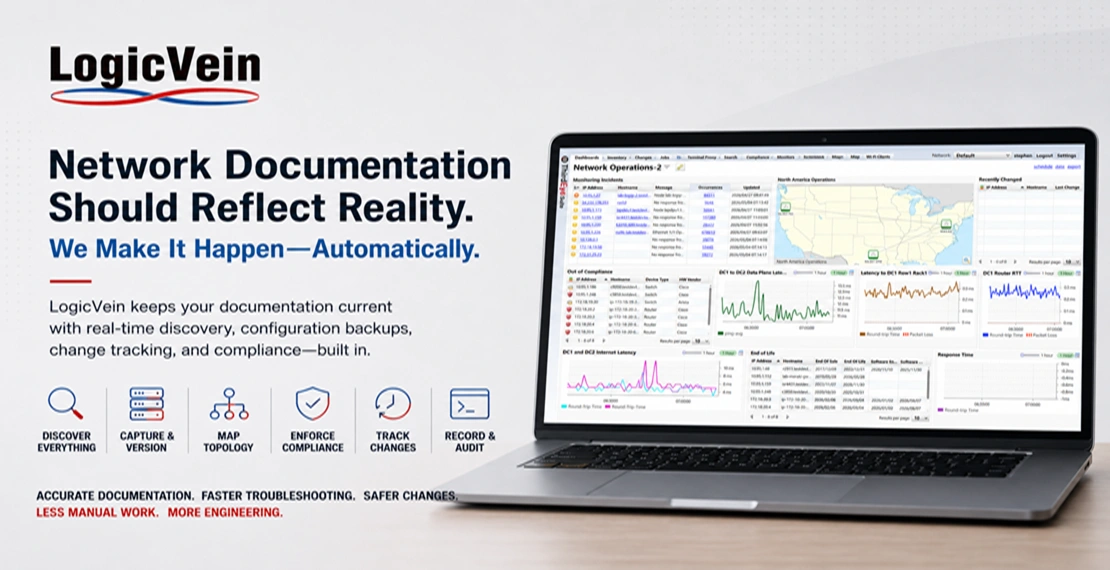
A modern approach doesn’t rely on people remembering to update anything. It continuously pulls data directly from the network:
-
Discovers devices in real time
-
Captures and versions configurations
-
Maps topology and neighbor relationships
-
Tracks OS and firmware versions
-
Records every change and who made it
-
Validates compliance continuously
The result is not a document—it’s a living system of record.
How LogicVein Closes the Documentation Gap
LogicVein takes this concept and embeds it directly into day-to-day operations. Documentation isn’t something you maintain—it’s something that happens automatically.
Continuous Discovery and Inventory
Devices are discovered using SNMP, SSH, and APIs, building a real-time inventory that updates as the network changes. No spreadsheets. No manual tracking.
Automated Configuration Backups and Versioning
Every configuration is captured and versioned—either on a schedule or triggered by change. You get a complete historical record:
-
What changed
-
When it changed
-
Who made the change
Without anyone writing it down.
Topology That Reflects Reality
Using CDP and LLDP, LogicVein builds relationship awareness between devices. Instead of static diagrams, you get accurate, continuously updated topology visibility.
Smart Change = Automatic Documentation
With Smart Change, bulk updates are executed with full logging, validation, and rollback. Every action is automatically recorded as part of the workflow. No more “we’ll document it later.”
Compliance Becomes Living Documentation
Policies are continuously enforced and validated against live configurations. Instead of documenting standards separately, LogicVein turns compliance into a real-time, enforceable system.
Terminal Proxy and Session Recording
All access through the platform can be logged and recorded. This creates a complete audit trail of operational activity—without requiring additional effort from engineers.
The Bottom Line
The most valuable documentation isn’t the most detailed. It’s the most accurate. And accuracy only happens when documentation is tied directly to the network itself. Manual documentation will always fall behind—because it depends on people. Automated documentation stays current—because it depends on the network.
Final Takeaway
With LogicVein, you don’t just react to changes — you control them.
Watch our series of videos here or see all our features here.
With its combination of discovery, monitoring, compliance, and automation, LogicVein transforms how IT teams manage complex network environments.
Whether you’re looking to reduce manual work, improve network reliability, or gain better visibility into device configurations, LogicVein will provide you the tools you need—all in a single platform.
Ready to see LogicVein in action? Request a Demo and discover how you can simplify operations, improve reliability, and gain full network visibility.