
Why Network Automation Is No Longer Optional
Enterprise networks are more complex than ever.
Modern infrastructure now spans data centers, branch offices, cloud platforms, remote users, SD-WAN deployments, wireless networks, firewalls, and hybrid environments. At the same time, organizations expect higher uptime, faster deployments, stronger security, and immediate response to operational problems.
Yet many IT teams are still managing critical infrastructure manually through CLI sessions, spreadsheets, isolated scripts, and disconnected operational processes.
That approach no longer scales.
Network automation has shifted from a future initiative to a core operational requirement for enterprise network teams.
The Problem with Manual Network Operations
Manual network management introduces operational inefficiencies that grow larger as environments expand.
Even highly experienced engineers face challenges when managing hundreds or thousands of devices individually.
Common operational problems include:
- Configuration inconsistencies
- Human error during changes
- Slow troubleshooting workflows
- Configuration drift between sites
- Delayed compliance validation
- Limited operational visibility
- Time-consuming maintenance tasks
- Difficulty scaling operational processes
In many organizations, engineers spend large portions of their day performing repetitive tasks such as:
- Logging into devices
- Backing up configurations
- Comparing configuration changes
- Applying standard updates
- Validating compliance settings
- Collecting troubleshooting information
- Updating documentation manually
These tasks are important, but they consume valuable engineering time while increasing operational risk.
Human Error Remains a Major Risk
Many network outages are not caused by hardware failure.
They are caused by operational mistakes.
A mistyped command, incorrect ACL entry, missing VLAN configuration, routing error, or incomplete deployment can quickly create widespread service disruptions.
As networks scale, the likelihood of operational mistakes increases dramatically.
Automation helps reduce this risk by standardizing workflows and enforcing consistency across devices and locations.
Instead of relying on engineers to manually repeat the same processes hundreds of times, automation platforms allow organizations to define approved operational procedures once and execute them consistently.
Standardization Improves Reliability
One of the biggest advantages of automation is operational consistency.
Automation helps ensure:
- Configurations remain standardized
- Compliance policies are validated automatically
- Backups occur on schedule
- Approved changes follow repeatable processes
- Device drift is detected quickly
- Documentation stays more accurate
- Multi-vendor operations become easier to manage
Without automation, even well-managed environments slowly drift over time as changes are applied manually by different engineers across different maintenance windows.
That inconsistency eventually creates troubleshooting complexity and operational instability.
Automation Improves Speed and Agility
Automation is often viewed simply as a way to save time.
The larger benefit is operational agility.
Automation allows network teams to:
- Deploy changes faster
- Perform bulk updates safely
- Accelerate troubleshooting
- Respond to outages more quickly
- Standardize deployments
- Reduce maintenance windows
- Validate changes automatically
Most importantly, automation improves speed without sacrificing operational control.
Well-designed automation platforms provide centralized visibility, audit tracking, rollback capabilities, and approval workflows that improve governance while reducing manual effort.
Visibility and Compliance Are Critical
Modern network operations require more than configuration deployment alone.
Organizations also need:
- Configuration version control
- Drift detection
- Compliance validation
- Change tracking
- Audit history
- Session visibility
- Centralized reporting
Without centralized visibility, teams often struggle to identify unauthorized changes, policy violations, or operational inconsistencies before they become larger problems.
Automation platforms help unify operational activity, governance, and visibility into a centralized operational workflow.
How LogicVein Helps Simplify Network Automation
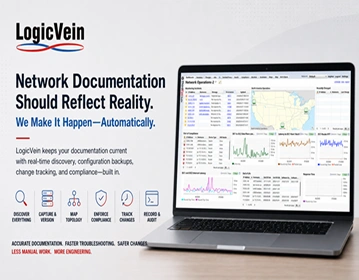
LogicVein helps organizations automate and standardize network operations without requiring teams to build and maintain large custom automation frameworks.
With capabilities such as:
- Automated configuration backups
- Configuration drift detection
- Compliance monitoring
- Smart Change bulk configuration deployment
- Change tracking and rollback
- Discovery and inventory collection
- Scheduled operational jobs
- Session visibility through Terminal Proxy
- Multi-vendor device support
- Centralized operational management
LogicVein helps reduce manual operational effort while improving consistency, visibility, and control.
For large enterprises and distributed environments, capabilities such as SmartBridge also help scale automation efficiently by allowing processing closer to remote sites while maintaining centralized operational management.
Network Automation Is Now an Operational Necessity
The discussion around automation has evolved.
Organizations are no longer asking whether automation is valuable. They are asking how quickly they can operationalize it safely.
Networks are simply too large and dynamic to manage effectively through entirely manual workflows.
Organizations that continue relying primarily on manual operations often experience:
- Increased operational risk
- Slower response times
- Greater configuration inconsistency
- Reduced scalability
- Higher operational overhead
- More troubleshooting complexity
Meanwhile, organizations adopting automation gain stronger operational consistency, faster deployments, improved governance, and better overall network reliability.
Conclusion
Network automation is no longer optional because modern network operations no longer scale manually.
Automation helps organizations reduce operational risk, improve efficiency, strengthen compliance, accelerate troubleshooting, and maintain consistency across increasingly complex environments.
The goal of automation is not to replace engineers.
The goal is to eliminate repetitive operational friction so network teams can focus on reliability, performance, security, and strategic initiatives.
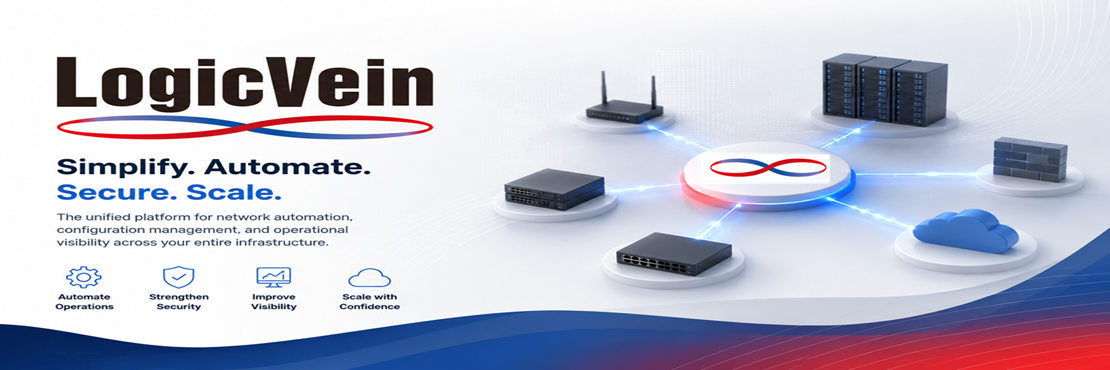
Platforms like LogicVein help organizations achieve that by combining automation, configuration management, compliance monitoring, and operational visibility into a centralized network operations platform.
Final Takeaway
With LogicVein, you don’t just react to changes — you control them.
Watch our series of videos here or see all our features here.
With its combination of discovery, monitoring, compliance, and automation, LogicVein transforms how IT teams manage complex network environments.
Whether you’re looking to reduce manual work, improve network reliability, or gain better visibility into device configurations, LogicVein will provide you the tools you need—all in a single platform.
Ready to see LogicVein in action? Request a Demo and discover how you can simplify operations, improve reliability, and gain full network visibility.